Consultations are generally offered in French: please confirm with the clinic (579 305-0344). The French version of this site prevails. Translation under professional review.
Male hormonal health · Saint‑HyacintheTestosterone
Male hormonal health and testosterone in Saint-Hyacinthe
Very real symptoms, a rigorous assessment before any treatment
Decreased sexual desire, erectile problems, fatigue, lack of energy, mood changes or decreased muscle strength: these symptoms are common and can affect quality of life.
They may be linked to testosterone deficiency, but also to many other factors: sleep, weight, stress, medication, cardiovascular or metabolic health.
At the Clinique IPS du Palais, we first seek to understand your situation as a whole.
During your consultation, the NP takes the time to assess your symptoms, your medical history, your past history, your medications, your lifestyle habits, your cardiovascular and metabolic health and your goals, including your plans to have children.
Testosterone may be one of the options when a deficiency is confirmed and treatment is appropriate, but it is never an automatic answer to fatigue or aging.
Our approach
Four principles for responsible care
1
Confirm before treating
Testosterone deficiency is not diagnosed on symptoms alone, nor on a single blood test.
Guidelines require both compatible symptoms and clearly and repeatedly low testosterone levels, measured in the morning.1, 2
About 30% of men whose first result is low get a normal result when the test is repeated.1
2
Look for all causes
Fatigue and low libido often have several causes. The NP assesses, among other things:
sleep and the possibility of sleep apnea;
weight and metabolic health;
medications;
mood and stress;
other health problems.
Weight loss, physical activity and regular sleep can also help increase testosterone levels.2
3
Individualize the decision
The decision whether or not to treat takes into account your symptoms, your age, your history, your risk factors, your plans to have children and your preferences.
In men aged 65 and over, guidelines advise against automatic treatment and favour an individualized decision after a discussion of the benefits and risks.1
4
Monitor and reassess
Testosterone treatment requires regular follow-up: changes in symptoms, tolerance, and monitoring of certain tests, including hematocrit (red blood cell concentration) and PSA (prostate-specific antigen).2
Treatment is adjusted, or stopped, based on the results and your situation.
When to seek care?
Signs that warrant an assessment
A male hormonal health consultation may be relevant if you have, for example:
decreased sexual desire
erectile problems
fatigue or low energy
mood changes
decreased muscle mass or strength
a low testosterone result obtained elsewhere
testosterone treatment already started
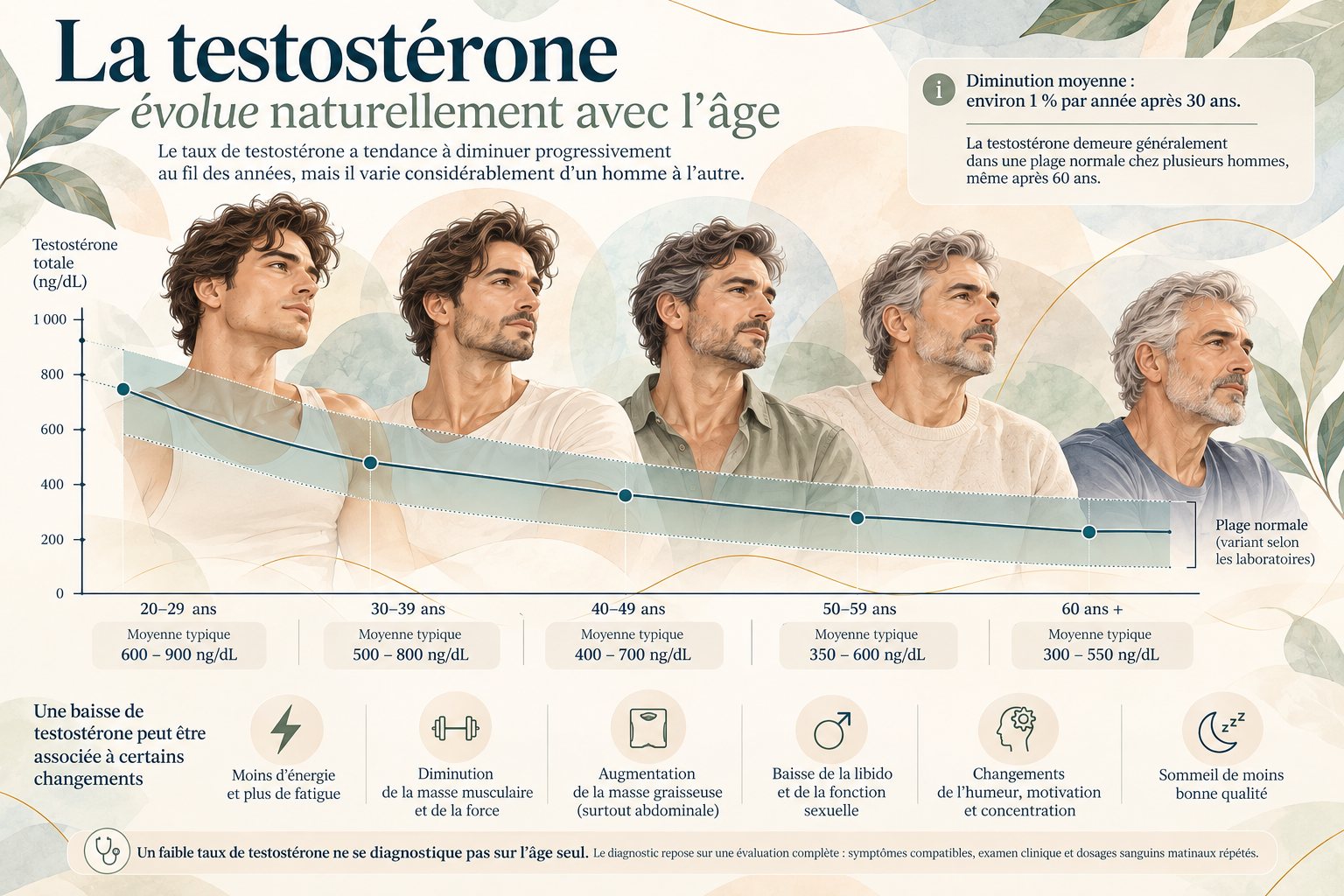
People often talk about “andropause,” but unlike menopause, there is no abrupt stop in men: testosterone instead tends to decline gradually with age, and not all men develop a deficiency requiring treatment.1
Wondering what the word “andropause” really means?
A level that changes differently from one man to another
For illustration purposes only. Reference values vary between laboratories and depending on the units used; only a clinical assessment can interpret your results.
A comprehensive assessment
We don’t reduce your health to a testosterone level
Depending on your situation, the NP may assess different aspects of your health:
Cardiovascular health
Blood pressure, risk factors, personal and family history.
Metabolic health
Weight, blood glucose, cholesterol and other parameters when relevant.
Sleep and fatigue
Sleep quality, sleep apnea and other possible causes of fatigue.
Sexual health
Sexual desire, erections and other concerns, addressed discreetly.
Plans to have children
An essential point to know before any hormone treatment.
Medication and lifestyle habits
Because treatment must fit into your reality and your overall health.
Important
Want to have children? Talk about it before any treatment
Testosterone taken as a treatment can reduce, or even suppress, sperm production and have a contraceptive effect.2
If you plan to have children, now or later, it is essential to discuss it with your NP: other options can then be discussed, with a medical specialist if needed.
To discuss during your consultation:
your plans to have children
your past or current treatments
your recent test results, if any
your goals and concerns
Your important questions
Heart, prostate, performance: let’s talk frankly
Is testosterone risky for the heart?
A large study published in 2023 (TRAVERSE) followed more than 5,000 men aged 45 to 80 with hypogonadism and cardiovascular disease or high cardiovascular risk.3
In that study, testosterone did not increase major cardiovascular events compared with placebo. However, more atrial fibrillation, acute kidney injury and pulmonary embolism were observed in the treated group.3
That is why your history and risk factors are assessed before deciding on treatment.
What about the prostate?
Prostate health is part of the assessment and follow-up. Among other things, guidelines call for PSA monitoring during treatment.2
Certain situations, such as prostate cancer, require special caution or may contraindicate treatment: they are discussed during the assessment.
Testosterone as an “anti-aging” treatment?
No. Testosterone treatment is reserved for men with a confirmed deficiency who have symptoms.1
It is not indicated to improve athletic performance, or to counter aging in a man whose levels are normal.
What if the problem is mainly weight or sleep?
That is common. Weight, sleep and physical activity influence testosterone levels.2
At the Clinique IPS du Palais, weight management and other health issues can be addressed in parallel, to act on the situation as a whole.
Our care pathway
Three appointments, at your own pace
1
Initial assessment
60 minutes
395 $
A first comprehensive assessment of your health, your symptoms and your hormonal concerns. The NP reviews your overall situation, your history, your health problems and the relevant metabolic factors.
The various options are explained in depth and all your questions can be addressed. Depending on the assessment, investigations may be ordered or treatment may be started at this visit.
2
Adjustment
45 minutes
295 $
A second visit to follow up on the initial assessment, review the results obtained and reassess your symptoms.
Depending on the situation, the NP may start, modify or adjust treatment and clarify the follow-up plan.
3
Follow-up
30 minutes
195 $
A visit usually scheduled about three months after the adjustment appointment.
It is used to assess changes in symptoms, response to treatment and tolerance, and then make the necessary adjustments.
What sets us apart
See the man before seeing the level
A man who consults for fatigue or low libido should not leave with a prescription before the cause is properly understood, nor have his symptoms dismissed.
Our role: confirm the diagnosis, look for all causes and work with you to build the most appropriate care plan.
Testosterone can be an excellent option when a deficiency is confirmed. For others, a different approach will be more effective. No hormone treatment is prescribed automatically: recommendations always depend on the clinical assessment and your personal situation.
Your PHCNP in hormonal health
Marie-Claude Tessier, PHCNP
Marie-Claude was trained in andropause in 2015 by Dr. Gilles Berthelot.
Since then, she has continued her training with Dr. Jean Drouin, notably at annual conferences, which allows her to support men as well as women.
At the Clinique IPS du Palais, Marie-Claude provides the assessment and follow-up in male hormonal health.
Frequently asked questions
Your questions about male hormonal health
Do I need a blood test before my appointment?
Not necessarily. Your NP will determine which tests are relevant. If you have recent results, bring them to your appointment. Testosterone is usually measured in the morning.2
Can I start treatment at the first appointment?
Sometimes. Diagnosis requires confirmed low testosterone levels. If these results are already available and the assessment allows it, treatment can be started at the first visit; otherwise, tests will be ordered first.
I’m already taking testosterone. Can I book a consultation?
Yes. The NP can review with you your current treatment, its effectiveness, side effects, doses and routes of administration, your risk factors and whether to continue or adjust the treatment.
Does testosterone affect fertility?
It can. Testosterone taken as a treatment can reduce sperm production. If you plan to have children, talk about it before any treatment.2
Should all men over 50 be tested?
No. Routine screening of healthy men is not recommended. An assessment is relevant when symptoms are present.1
Discreet, personalized care
You don’t need to know before your appointment whether a treatment is right for you. That is precisely the purpose of the consultation: to understand what you are experiencing, assess your health as a whole and determine with you the most appropriate care.
Bhasin S, Brito JP, Cunningham GR, et al. Testosterone Therapy in Men With Hypogonadism: An Endocrine Society Clinical Practice Guideline. The Journal of Clinical Endocrinology & Metabolism, 2018;103(5):1715-1744. endocrine.org
Grober ED, Krakowsky Y, Khera M, et al. Guide de pratique de l’Association des urologues du Canada sur le déficit en testostérone chez l’homme : questions et réponses. Journal de l’Association des urologues du Canada (CUAJ), 2021;15(5). cua.org
Lincoff AM, Bhasin S, Flevaris P, et al. Cardiovascular Safety of Testosterone-Replacement Therapy (TRAVERSE trial). New England Journal of Medicine, 2023;389(2):107-117. nejm.org
The information on this page is provided for information purposes only and does not replace a consultation with a health professional.