Consultations are generally offered in French: please confirm with the clinic (579 305-0344). The French version of this site prevails. Translation under professional review.
Pregnancy · Saint‑HyacinthePrenatal follow-up
Pregnancy follow-up in Saint-Hyacinthe
Understand each step, ask your questions and get support in your decisions.
Finding out you are pregnant can bring joy, questions and sometimes worries. Which tests should you plan for? When should you make an appointment? Can you continue your medications? Which changes are usual and which ones warrant a consultation?
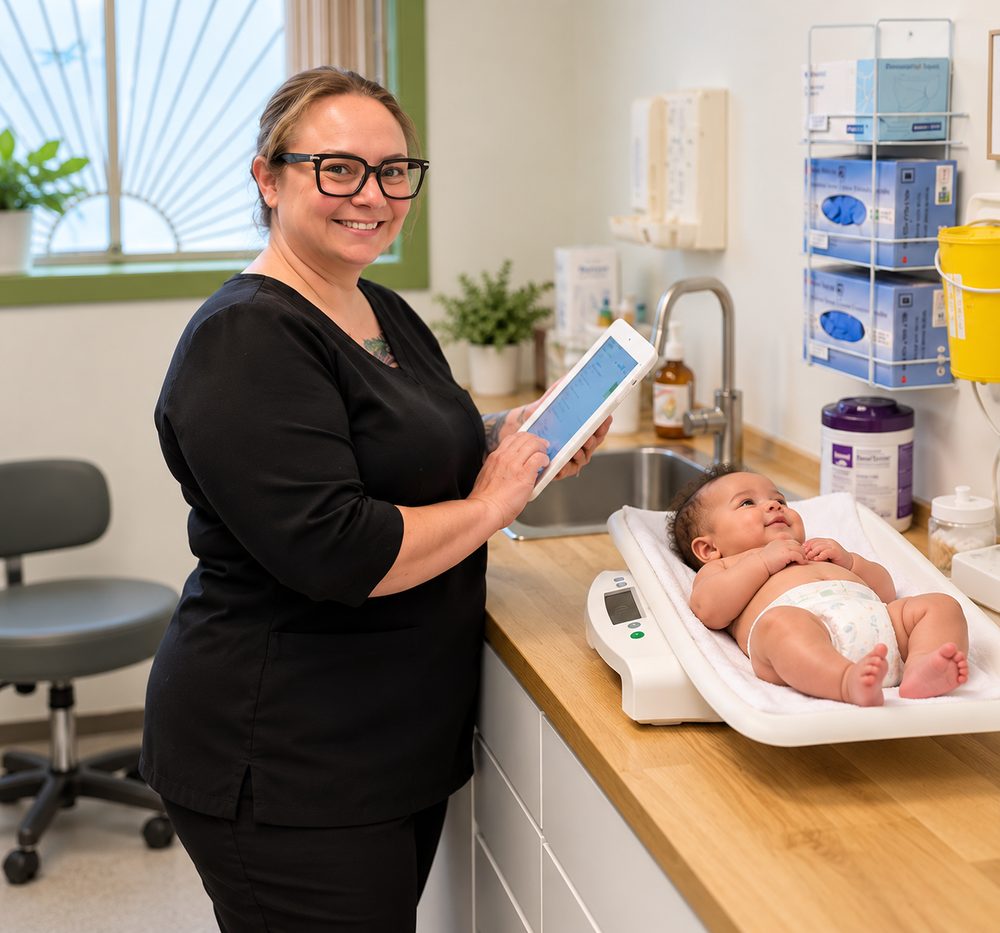
At Clinique IPS du Palais, we offer pregnancy follow-up provided by a duo: a primary care nurse practitioner (PHCNP) and a clinical nurse, who work hand in hand. The goal is to monitor your health and the progress of your pregnancy, while giving you clear explanations about the steps ahead.
Our approach takes into account your health history, your emotional well-being, your daily life and your preferences.
8 to 11 weeksFirst consultation and planning of tests
10 to 13 weeks incl.Blood test for biochemical screening, if this option is chosen
11 to 13 weeks incl.First-trimester ultrasound; nuchal translucency depending on availability and the patient’s choice
19 to 22 weeksMorphology ultrasound
24 to 28 weeksGestational diabetes screening
Around 36 weeksSample collection for group B streptococcus
Why follow-up matters
Why is pregnancy follow-up important?
Even when you feel well, prenatal follow-up makes it possible to monitor things that do not always cause symptoms, such as a rise in blood pressure, anemia or diabetes of pregnancy.
It also makes it possible to plan tests at the right time, understand their results and adapt care if your situation changes.
Appointments are also a space to talk about what you are going through:
Physical discomfort.
Worries.
Sleep.
Work.
Family life.
Preparing for the baby’s arrival.
You do not need to wait for a problem to arise to ask your questions.
Your team
A PHCNP and clinical nurse duo
The first assessment determines whether your pregnancy can be followed in our setting. If additional expertise is needed, the arrangements for collaboration or referral are explained to you.
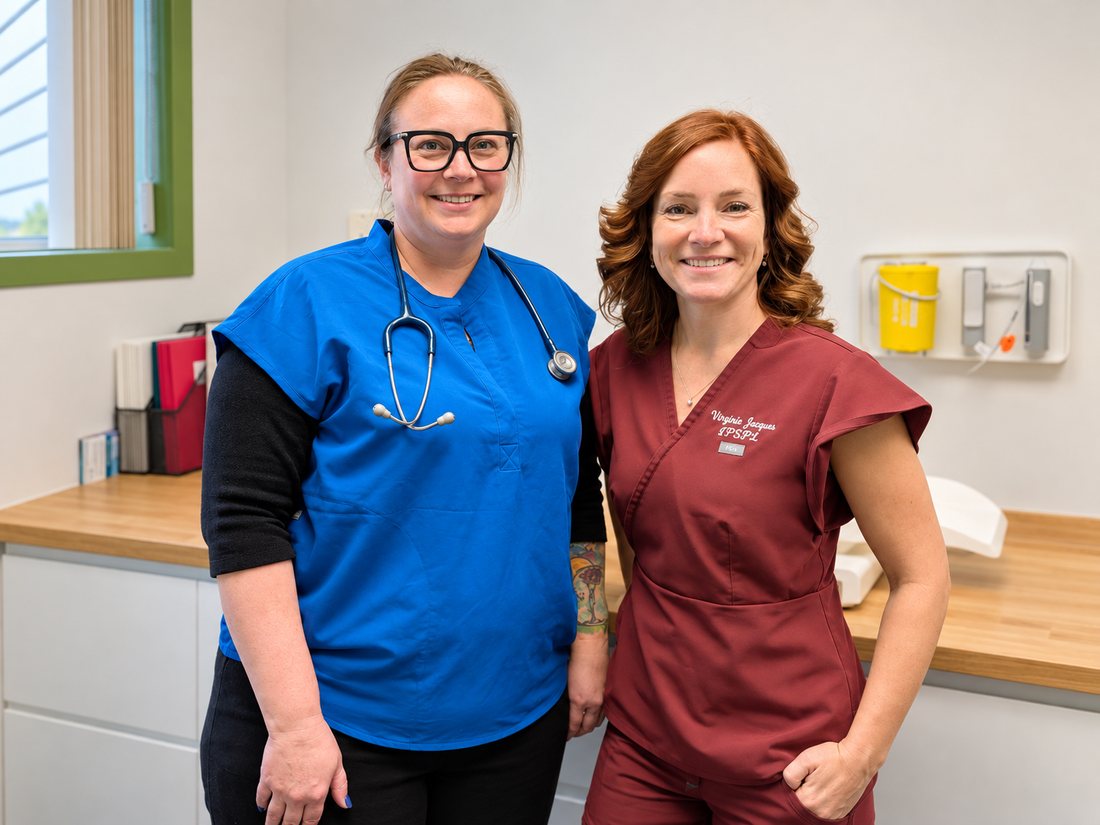
Virginie Sénécal, clinical nurse, and Virginie Jacques, PHCNP
What is the role of the PHCNP?
The primary care nurse practitioner has advanced training that allows her, among other things, to assess your health, diagnose health problems and prescribe tests and treatments within her scope of practice.
As part of pregnancy follow-up, she can, among other things:
Assess your health and the factors that may influence the pregnancy.
Prescribe relevant lab tests and examinations.
Interpret the results and explain the next steps.
Assess certain symptoms and propose appropriate management.
Discuss medications, supplements and preventive measures.
Recognize situations that require a consultation or specialized care.
What is a clinical nurse?
A clinical nurse is a nurse with a university education in nursing. She plays an essential role in the assessment, prevention, education and follow-up of your health.
At Clinique IPS du Palais, the clinical nurse works closely with our PHCNPs. Depending on the reason for your visit, she may welcome you, carry out an initial assessment, provide the required care and ensure the continuity of your follow-up.
MarjolaineRegistered nurse (technical training)
First contact
When to contact the clinic?
As soon as your pregnancy test is positive, you can contact our team to plan the start of your follow-up.
8 to 11 weeks
The first consultation usually takes place between 8 and 11 weeks of pregnancy. However, it is best to get in touch earlier to organize the appointments and tests offered in the first trimester.
Earlier if needed
An earlier assessment may be needed if you have symptoms, a known illness, a particular medical history or questions about your medications.
If your pregnancy is already further along, contact us to find out about the care options available.
First visit
How does the first visit go?
1
Taking stock of your health
The first consultation provides an overview of your situation. Among other things, we discuss:
Your current and past health problems.
Your previous pregnancies and how they went.
Your medications, natural products, vitamins and allergies.
Relevant family history.
Your symptoms since the beginning of the pregnancy.
Your diet, physical activity and lifestyle habits.
Your work context, your support and your emotional state.
This information helps personalize the follow-up and determine whether certain precautions are needed.
2
Assessing the stage of the pregnancy
The date of your last menstrual period and the usual length of your cycles help estimate the number of weeks of pregnancy and the due date.
An ultrasound may complete this assessment and refine the dating depending on the situation.
3
Planning the next steps
A physical examination adapted to your needs is offered to you. We then discuss the relevant lab tests, ultrasounds and screening options.
You can ask what each test is for, what it can reveal and what it cannot tell you.
Tests
What are tests for during pregnancy?
Tests do not all have the same purpose. Some assess your health, others provide information on the baby’s development or on the likelihood of certain conditions.
Blood tests and urine tests
Depending on your situation, they make it possible, among other things, to:
Check for anemia.
Determine your blood type and Rh factor.
Check certain aspects of your protection against infections, for example antibodies against rubella.
Screen for infections that may require treatment or precautions, such as syphilis, HIV or hepatitis B.
Check for bacteria or protein in the urine, even without symptoms.
Assess your blood sugar as part of screening for diabetes of pregnancy.
An initial set of tests is prescribed early in pregnancy. Some tests are then repeated or added depending on the stage of the pregnancy, the results and your clinical situation. Your health professional will tell you when to have them done.
Tests are chosen according to the applicable recommendations, your health history and the stage of the pregnancy. Additional tests may be needed if symptoms or results warrant them.
Ultrasounds
Depending on when they are performed, ultrasounds can help, among other things, to determine the gestational age more precisely, determine the number of babies and examine their development.
An early ultrasound may be prescribed as needed, for example to refine the dating of the pregnancy. The morphology ultrasound is usually performed between 19 and 22 weeks. You will be given the ultrasound schedule during your follow-up.
The first-trimester ultrasound, during which nuchal translucency may be measured, is part of prenatal screening: it is presented in the section Understanding prenatal screening.
They provide important information, but cannot detect all abnormalities or guarantee the absence of a problem.
The prescription, timing and location of the ultrasounds will be specified during your follow-up.
Screening for diabetes of pregnancy (gestational diabetes)
Diabetes of pregnancy is an elevated blood sugar level during pregnancy. Because it can be present without obvious symptoms, a screening test is usually offered between 24 and 28 weeks, sometimes earlier depending on risk factors.
The test measures your blood sugar after you have drunk a sugary liquid.
If a diagnosis is made, appropriate management is arranged.
Group B streptococcus screening
Toward the end of pregnancy, usually around 36 weeks, a vaginal and anal swab is offered to check for this bacterium.
It can be present without making you sick, but its presence may change the precautions to take during labour in order to protect the baby. The result must therefore be known to the team that will be with you at delivery.
If the bacterium is present, antibiotic treatment is offered to you at the time of labour.
Prenatal screening
Understanding prenatal screening
The Programme québécois de dépistage prénatal (Quebec prenatal screening program) aims to assess the likelihood that the baby has trisomy 21, 18 or 13.
Prenatal screening options are discussed at the first consultation in order to plan tests at the right time. In the Programme québécois de dépistage prénatal, the blood test for biochemical screening is done between the 10th and 13th week inclusive. A first-trimester ultrasound is offered between the 11th and 13th week inclusive; nuchal translucency measurement may also be offered during this exam. The pathway may vary depending on your situation and the test chosen.
Depending on your situation and the results obtained, different steps may be offered, including a blood test, an ultrasound measurement of nuchal translucency or a non-invasive prenatal genomic test (NIPT).
NIPT is a blood test that can be done from the 10th week for a single pregnancy and from the 12th week for a twin pregnancy.
A screening test is not a diagnosis.
A result indicating a high likelihood does not automatically mean that the baby has the condition being screened for. Additional tests may be offered to clarify the situation. Only a diagnostic test can determine this with a high degree of certainty.
Participation is voluntary. You can accept or decline screening after receiving the necessary explanations, according to your values and preferences.
Our role is to help you understand the options, their limitations and their implications, without imposing a decision on you.
Subsequent appointments
What is checked during subsequent appointments?
Visits provide an opportunity to review your health and the progress of the pregnancy.
The frequency of consultations is adapted to your needs and generally increases toward the end of pregnancy. If a situation requires special monitoring, the schedule or location of follow-up may be changed.
Depending on the stage of the pregnancy, the assessment may cover, among other things:
Your blood pressure and weight changes.
Your symptoms and general condition.
The results of tests performed.
The growth of the uterus.
The baby’s heartbeat and movements.
Your emotional well-being and the questions on your mind.
How often?
The usual frequency of consultations
As a guide, the INSPQ indicates the following usual frequency:
1
12 to 30 weeks
One consultation every 4 to 6 weeks.
2
31 to 36 weeks
One consultation every 2 or 3 weeks.
3
37 weeks and over
One consultation per week, until delivery.
Day to day
Advice tailored to your daily life
Follow-up is also an opportunity to discuss everyday habits and choices:
Diet, prenatal vitamins and folic acid.
Physical activity, rest and sleep.
Alcohol, tobacco or cannabis use.
Medications and over-the-counter products.
Infection prevention and vaccination.
Work-related constraints.
Preparing for childbirth and for feeding the baby.
Advice is tailored to your health and your situation.
Even a product available without a prescription or presented as “natural” should be checked during pregnancy.
Emotional health
Your emotional health matters too
Pregnancy can bring a range of emotions. You may feel happy while also being worried, overwhelmed or more vulnerable.
Persistent sadness, loss of interest or significant difficulty functioning should be addressed. You can talk about it during your appointment.
When depression is present, psychological, psychosocial or medication-based interventions may be considered. The choice takes into account your situation, the expected benefits, the risks and your preferences.
Recognizing the signs
Some changes are normal during pregnancy. It is considered depression when the symptoms have a significant impact on functioning and daily life. Among the signs described by the INESSS:
Fatigue.
Changes in appetite.
Intense emotions.
Loss of interest in the pregnancy.
Missed medical appointments.
If you take an antidepressant, do not change or stop it without discussing it with your health professional. A pregnancy does not automatically mean that treatment must be stopped. According to the INESSS, pregnancy and breastfeeding are not incompatible with taking an antidepressant, and stopping too quickly can pose risks for you and your baby.
811, option 2Info-Social, to speak with a psychosocial worker.
1 866 APPELLE(1 866 277-3553) or suicide.ca, if you are having suicidal thoughts.
Toward delivery
How is the path toward delivery organized?
Pregnancy follow-up at the clinic and care during delivery are two separate components.
The arrangements for continuity of care are discussed with you: the team that will take over, the steps to take and the information to share.
If your pregnancy requires specialized care, a referral is arranged as needed. The goal is for you to know who is providing your follow-up and whom to turn to at each stage.
Before your appointment
How should you prepare for your appointment?
To make the first visit easier, prepare:
You can write down your questions as they come up: no worry is too small to be discussed.
The date of the start of your last menstrual period, if you know it.
Your list of medications, vitamins and supplements.
Results of any lab tests or ultrasounds already done.
Important information about your previous pregnancies.
The questions you would like to discuss.
Frequently asked questions
Your questions about pregnancy follow-up
I feel well. Do I still need follow-up?
Yes. Some problems can develop without symptoms. Follow-up makes it possible to monitor your health, offer the relevant tests and plan care at the right time.
Can all pregnancies be followed at the clinic?
Whether follow-up is possible depends on your health, the particular features of your pregnancy and how the service is organized. An assessment determines the setting and the professionals best suited to your needs.
Is prenatal screening mandatory?
No. You can choose whether or not to participate. Your health professional explains what the tests can offer and their limitations in order to support your decision.
Can I continue my medications?
It depends on the medication and the reason you are taking it. Some treatments can be continued, while others require reassessment. Do not change a prescribed treatment on your own: have it checked by your health professional or your pharmacist.
Does a normal ultrasound guarantee that everything is fine?
No. An ultrasound provides useful information about the pregnancy and the baby’s development, but it does not detect all conditions. It complements the other elements of follow-up.
Can I talk about my anxiety or personal difficulties?
Yes. Your emotional health and your environment are part of your overall health. The appointment is a space to talk about them and, if needed, determine which resources could help you.
Warning signs
When should you seek care quickly?
Some symptoms require an assessment without waiting for the next appointment. Here are the warning signs described by the INSPQ. When in doubt, it is always better to call.
Vaginal bleeding
Before 14 weeks, light bleeding often occurs in early pregnancy. Light bleeding after a gynecological exam does not require assessment; in other cases, see a health professional. Go to the emergency department quickly if the bleeding is heavy (two regular sanitary pads or one maxi pad per hour, for two to three hours in a row) or if it is accompanied by weakness, dizziness or severe abdominal pain.
After the first trimester, vaginal bleeding is not normal: seek care quickly.
Fewer baby movements
After 26 weeks, if you no longer feel your baby move or if the baby is moving less than usual, rest and observe. If you count fewer than six distinct movements in two hours, contact your birthing facility quickly.
Contractions before 37 weeks
Irregular (Braxton-Hicks) contractions are normal. Before 37 weeks, contact your team if you have regular or frequent contractions (more than seven in a day), especially with an increase in vaginal discharge.
Loss of amniotic fluid
This is a continuous or repeated loss of clear, odourless fluid that can soak a pad in 30 minutes. Before 37 weeks, call immediately or go to the hospital. At 37 weeks or more, go to your birthing facility.
Fever
Fever is an oral temperature of 38°C or higher. Seek care if it lasts more than 24 hours, reaches 38.5°C or higher, or if you feel unwell.
Other warning signs
Severe headaches, band-like pain in the upper abdomen or a sudden change in vision.
Generalized swelling (legs, hands, face).
Severe abdominal pain.
Chest pain and sudden shortness of breath.
Pain and swelling in only one leg.
Fainting.
Significant blow to the abdomen.
Contact your follow-up team, your hospital’s obstetrics department or your birthing facility quickly, or go to the emergency department depending on the situation.
911In case of distress or immediate danger.
811Info-Santé, to speak with a nurse when the situation is not urgent.
Do not wait for a reply to an online form if you have urgent symptoms.
Support for you and your pregnancy
Would you like to start follow-up or find out about care options at Clinique IPS du Palais?
Our team can inform you about how the service works and schedule a first visit in Saint-Hyacinthe.
Institut national de santé publique du Québec (INSPQ). Mieux vivre avec notre enfant de la grossesse à deux ans, 2026 edition, “Suivi de grossesse,” updated February 17, 2026, accessed September 28, 2026. inspq.qc.ca
INSPQ. Mieux vivre avec notre enfant de la grossesse à deux ans, 2026 edition, “Signaux d’alarme pendant la grossesse,” updated February 17, 2026, accessed September 28, 2026. inspq.qc.ca
Government of Quebec. Programme québécois de dépistage prénatal, updated May 6, 2024, accessed September 28, 2026. quebec.ca
Government of Quebec. Services offerts par les infirmières praticiennes spécialisées, updated April 15, 2024, accessed September 28, 2026. quebec.ca
Institut national d’excellence en santé et en services sociaux (INESSS), Marie-Pierre Rousseau and Annik Moreau. Trouble dépressif caractérisé pendant la grossesse, July 15, 2024, and fact sheet Trouble dépressif pendant la grossesse : vos options pour un choix de traitement éclairé, July 2024, accessed September 28, 2026. inesss.qc.ca — fact sheet (PDF)
Morphology ultrasound schedule (19 to 22 weeks): Clinique IPS du Palais practice.
The information on this page is provided for information purposes only and does not replace a consultation with a health professional.