Consultations are generally offered in French: please confirm with the clinic (579 305-0344). The French version of this site prevails.
Health education · Pelvic healthPrevention and overall health
Urinary leakage and the pelvic floor: understanding it and knowing when to seek care
A few drops when you cough, a sudden urge that is hard to hold, or the worry of not reaching the toilet in time can affect your activities and your confidence.
Urinary leakage is worth talking about. It is not an unavoidable part of aging, and several approaches can help reduce it. This page is intended for adults.
Urinary incontinence means an involuntary loss of urine. It can range from a few drops to larger leaks.8
The circumstances in which it happens give useful clues for the assessment.
Type of incontinence
How it can show up
Stress
Leakage when you cough, sneeze, laugh, jump or exercise.8
Urge (urgency)
A sudden urge that is hard to hold, followed by leakage before you reach the toilet.8
Mixed
A combination of stress leakage and leakage linked to sudden urges.8
These descriptions help you understand the symptoms, but they are not enough to make a diagnosis.
Other forms exist. Leakage can occur when an overfilled bladder does not empty well, or when pain, weakness or cognitive difficulties make it hard to reach the toilet in time.2,7
The pelvic floor
What does the pelvic floor do?
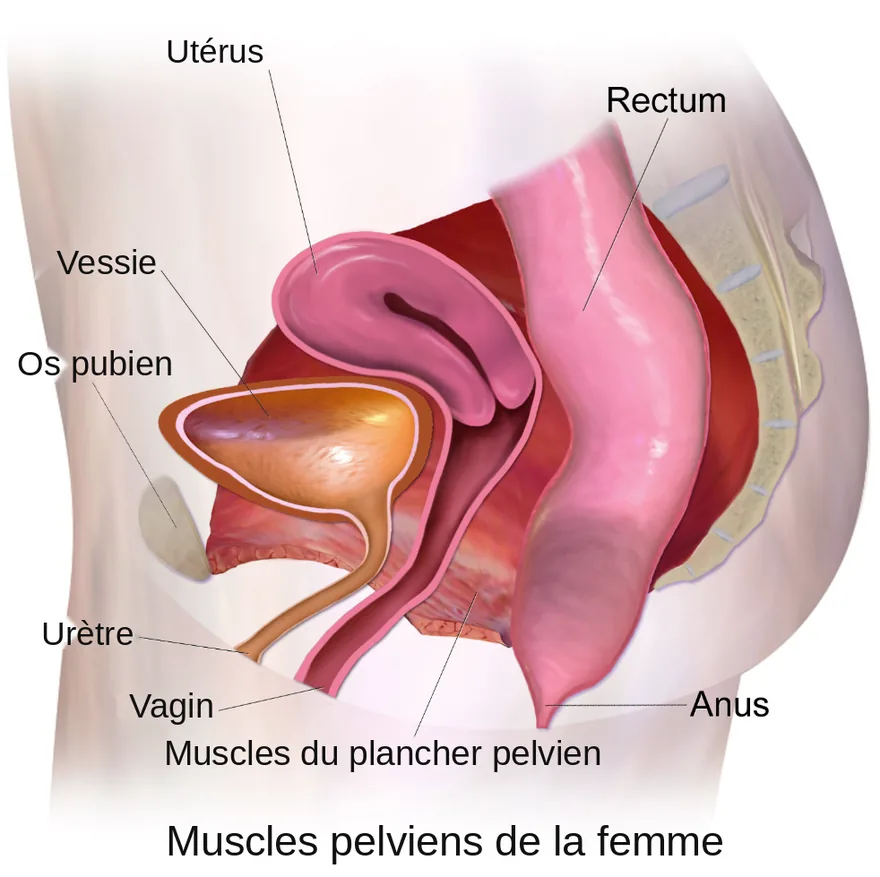
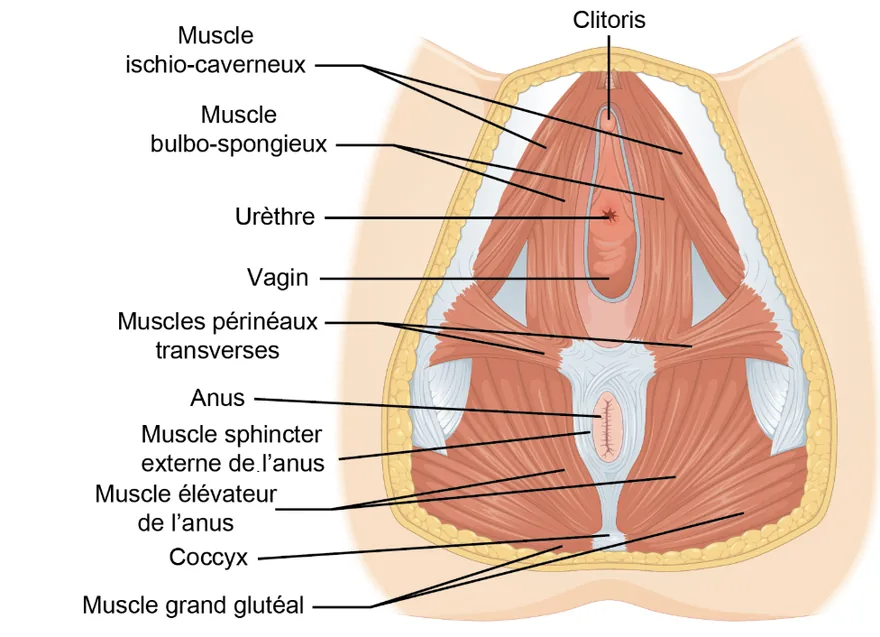
The pelvic floor is a group of muscles and tissues at the bottom of the pelvis. It supports the bladder and rectum, and the uterus in people who have one. The way it works helps control urine.5
These muscles need to be able to contract and relax.5
A pelvic floor can be:
weakened;
too tight;
unable to relax easily.
Excess tension can come with pelvic pain, difficulty urinating or discomfort during sex.5
Side view: the pelvic floor muscles support the bladder, uterus and rectum.Illustration: BruceBlaus, 2017, Wikimedia Commons, licence CC BY-SA 4.0. Labels translated into French by the Clinique IPS du Palais.View from below: the perineal and pelvic floor muscles surround the urethra, vagina and anus.Illustration: OpenStax, French adaptation by Girart de Roussillon, 2024, licence CC BY-SA 3.0.
The labels on these diagrams are in French.
Doing more contractions is therefore not always the right answer. An assessment helps tailor the advice to your situation.
Causes
Why does urinary leakage happen?
Several factors can contribute to the symptoms.
Not all leakage is due only to a lack of muscle strength. Finding the cause helps choose the right treatment.
weak pelvic floor muscles or a problem with how the urethra closes;
constipation, some medications or a urinary tract infection;
a problem with the bladder or with the nerves involved in bladder control.
Assessment
What happens during the assessment?
Depending on the situation, a physical exam, a urine test or other tests may be offered. Not every patient needs the same tests.1,7
Your health professional may ask about:
when the symptoms started and how they have changed;
how often you leak and what triggers it;
sudden urges and trips to the toilet;
related symptoms, such as pain or difficulty urinating;
your medications, your health history and the impact on your daily life.
The bladder diary
For a few days, write down what you drink, your trips to the toilet, sudden urges and leaks.2 Also bring your list of medications to the appointment.
Solutions
What solutions can help?
The choice depends on the type of incontinence, how severe it is, the treatments already tried and your preferences.
Adjusting some habits
Depending on your symptoms, you may be advised to:2,3
review your caffeine intake;
prevent or treat constipation;
adjust your drinking habits;
make the toilet easier to reach if moving around is difficult.
Bladder retraining may also be offered to gradually work on urinary habits and on managing sudden urges.2
Pelvic floor physiotherapy
A physiotherapist trained in pelvic floor rehabilitation can assess how the muscles work and suggest a personalized program.4
Depending on your needs, the program may work on strength, endurance, coordination or relaxation.8
Considering other treatments
Depending on the cause and the results of the assessment, medication, a pessary for some people, a specialist referral or a procedure may be offered.3
Sharply cutting back on water is not something to do routinely. More concentrated urine can irritate the bladder. Advice on fluids must take your health into account.2
For stress urinary incontinence in women, Canadian guidelines recommend a supervised pelvic floor muscle training program of about three months as first-line treatment.3 Progress requires regular practice.
Exercises
Are Kegel exercises right for everyone?
No. They can help when strengthening is needed, but they can make some symptoms worse when the muscles are already too tight.5
If you have pelvic pain or trouble relaxing the muscles, get assessed before you start.5,8
A new loss of bladder or bowel control together with numbness or loss of sensation in the genital or perineal area or in the legs also needs immediate assessment.7
If in doubt, call Info-Santé 811, option 1, for guidance.
Frequently asked questions
Your questions about urinary leakage
Can men have urinary leakage too?
Yes. Leakage can occur after a prostate procedure, for example. An assessment helps find the cause.1
Should I seek care for leakage after giving birth?
Pregnancy and childbirth increase the risk of leakage, but the symptoms are worth discussing.8 Pelvic floor rehabilitation can be part of the care.4
Does a frequent urge to urinate mean I have incontinence?
No. Incontinence means an involuntary loss of urine. Frequent or sudden urges can occur without any leakage.
Can symptoms improve without surgery?
Yes. Pelvic floor rehabilitation, changes in habits and other treatments can help.2,3 The right options depend on your situation.
Would you like to talk about it?
Urinary leakage can be discussed simply, without embarrassment. To request an assessment and discuss your symptoms, contact the Clinique IPS du Palais in Saint-Hyacinthe.
Centre hospitalier de l’Université de Montréal (CHUM), Centre de littératie en santé. L’incontinence urinaire chez la personne âgée — Exercices et traitements. Révision de décembre 2022. chumontreal.qc.ca
Carlson K, Andrews M, Bascom A, et coll. 2024 Canadian Urological Association guideline: Female stress urinary incontinence. Can Urol Assoc J. 2024;18(4):83-102. pmc.ncbi.nlm.nih.gov
Institut national d’excellence en santé et en services sociaux (INESSS). La rééducation périnéale et pelvienne pour la prévention et le traitement des dysfonctions du plancher pelvien. 8 mai 2023. inesss.qc.ca
Défense nationale, gouvernement du Canada. Guide sur la santé urinaire, section sur le plancher pelvien. Sans date retenue. canada.ca
Santé Québec. Infection urinaire ou douleur en urinant (conseils santé). Mise à jour le 8 octobre 2026. sante.quebec
Centre hospitalier de l’Université de Montréal (CHUM), Centre de littératie en santé. Prévenir et traiter l’incontinence urinaire chez la femme. Révision de juin 2022. chumontreal.qc.ca
This page is intended for adults. It provides general information and does not replace a personalized assessment. Published on October 31, 2026.