Consultations are generally offered in French: please confirm with the clinic (579 305-0344). The French version of this site prevails. Translation under professional review.
Health education · Kids' cornerPregnancy and pediatrics
Children's health explained in comics
Illustrated stories with Clara to discover care, gently.
A visit to a health professional can seem intimidating for a child. Knowing ahead of time what will happen often helps them feel more confident.
In our comics, Clara guides children step by step: we look, we explain, we reassure. Get comfortable and read them together, at your own pace.
Coming soonMore stories are on the wayClara is preparing new comics to explain other types of care to children. Come back and see us!
Comic No 1 · Cough and mask
I cough, I protect others!
A comic to learn good habits when you cough and how to wear a mask properly. The comic is in French; the full text is available in English below.
1 page Clara's adventuresEnlarge the pageRead the comic text in English
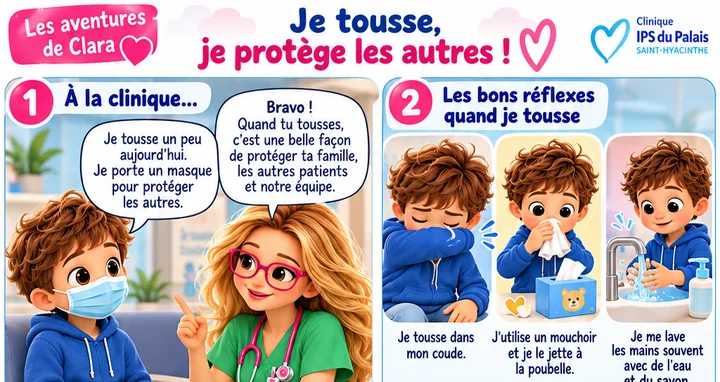
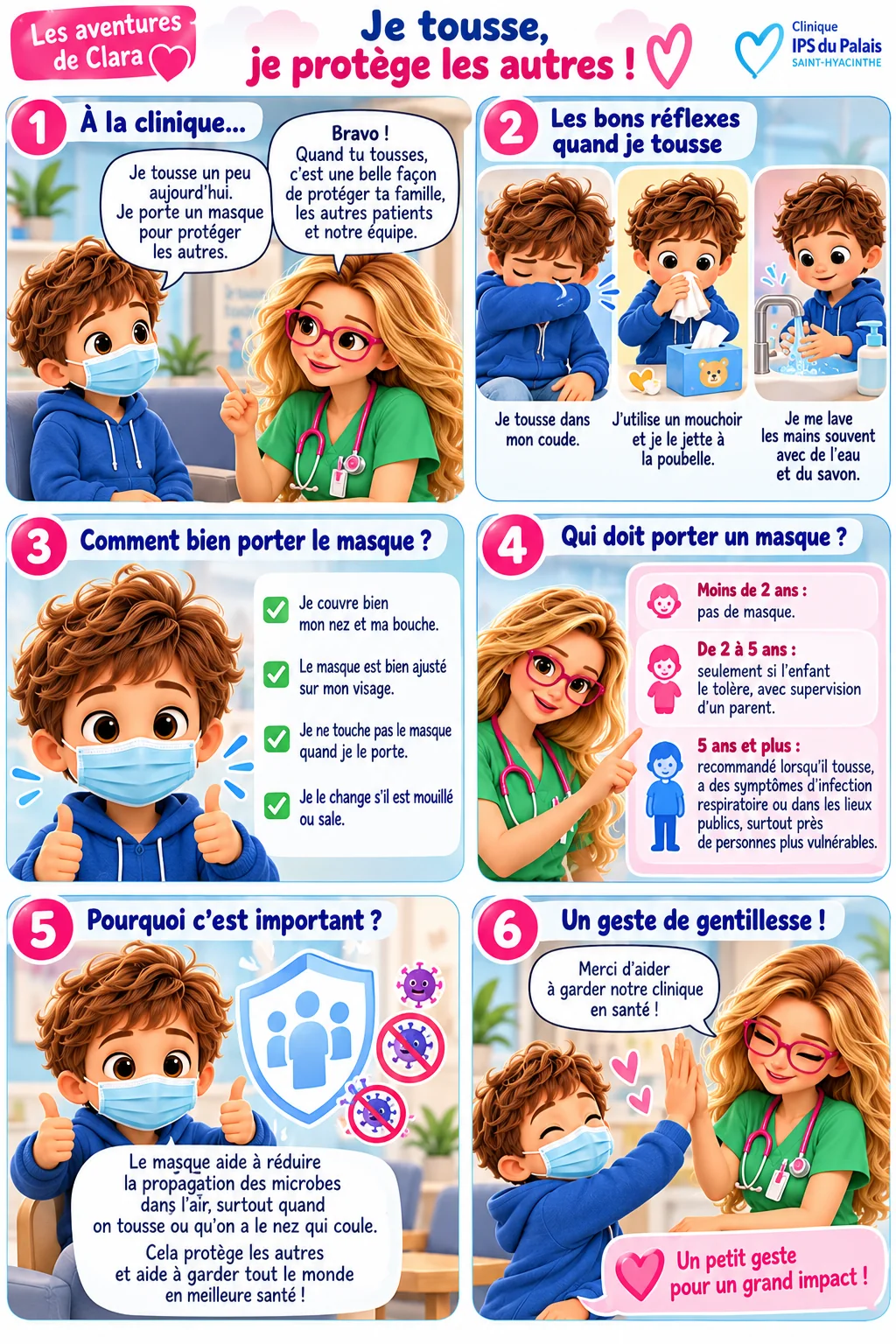
Clara's adventures — I cough, I protect others!
1. At the clinic…
The child: “I'm coughing a little today. I'm wearing a mask to protect others.”
Clara: “Well done! When you cough, it's a great way to protect your family, the other patients and our team.”
2. Good habits when I cough
I cough into my elbow.
I use a tissue and throw it in the garbage.
I wash my hands often with soap and water.
3. How do I wear a mask properly?
I cover my nose and mouth well.
The mask fits snugly on my face.
I don't touch the mask while I'm wearing it.
I change it if it's wet or dirty.
4. Who should wear a mask?
Under 2: no mask.
Ages 2 to 5: only if the child tolerates it, with a parent's supervision.
Age 5 and over: recommended when they cough, have symptoms of a respiratory infection or in public places, especially near more vulnerable people.
5. Why does it matter?
A mask helps reduce the spread of germs in the air, especially when you cough or have a runny nose.
It protects others and helps keep everyone healthier!
6. A kind gesture!
Clara: “Thank you for helping keep our clinic healthy!”
“A small gesture for a big impact!”
For parents: good to know
Wearing a mask is recommended for people who have symptoms of an infectious respiratory illness, until their symptoms are gone. A mask may be required in some places where care is provided.
For children: no mask before age 2; from 2 to 5, only under supervision, if the child tolerates it and can put it on and take it off; from age 5, in the same situations as adults.
To wear it properly: over the nose and mouth, fitted under the chin; avoid touching it; change it if it is damp, soiled or damaged; wash your hands before and after putting it on.
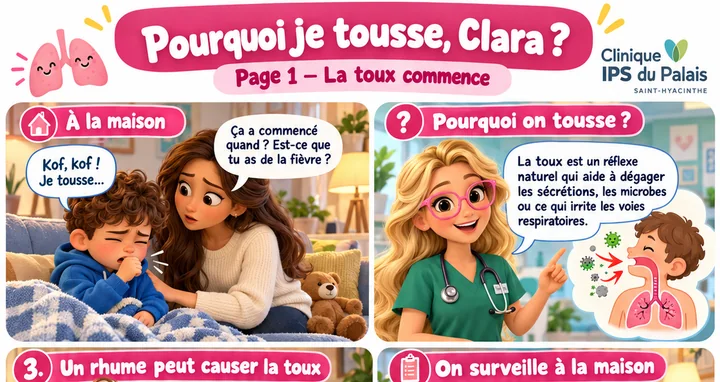
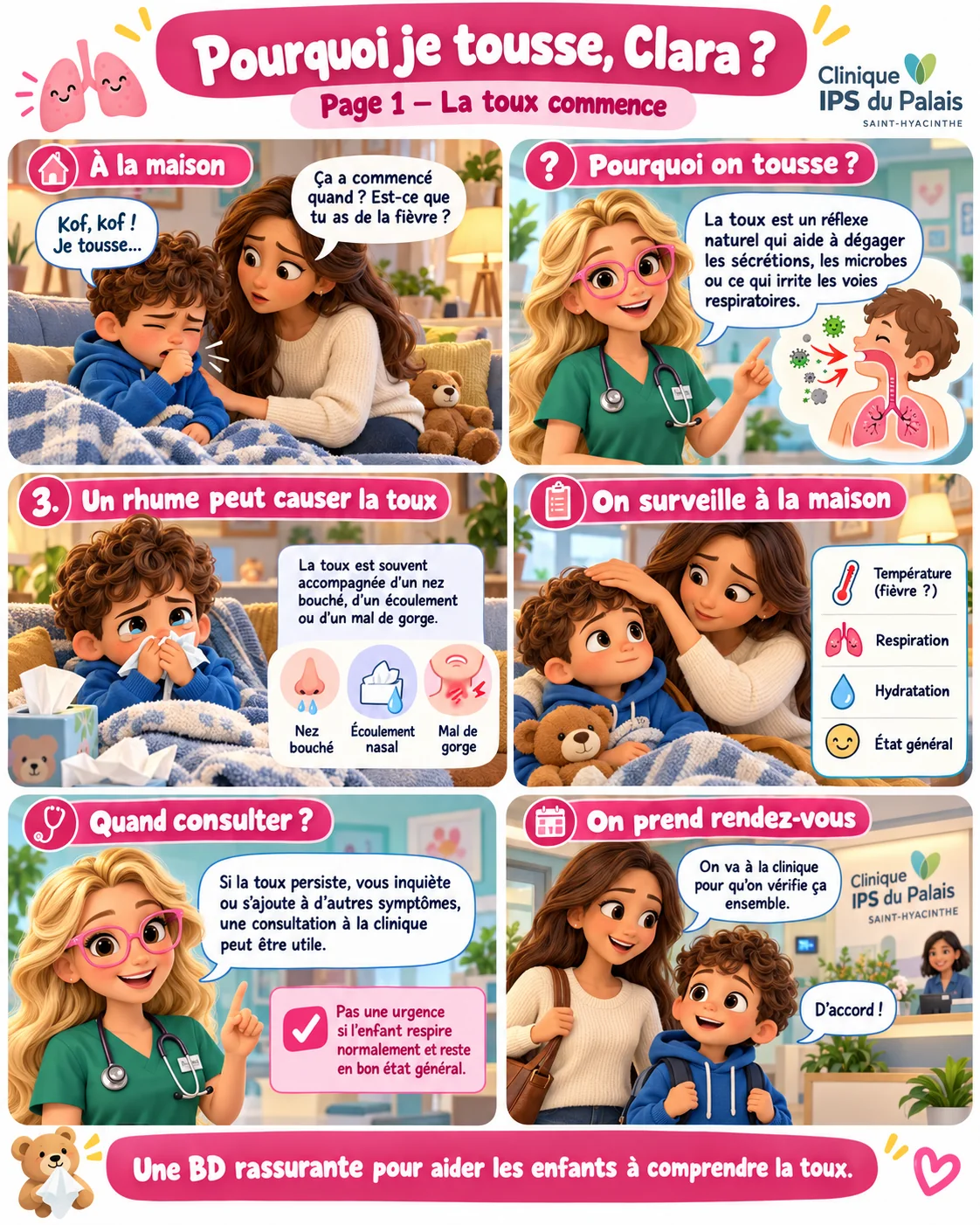
A reassuring comic to help children understand coughing: where it comes from, how to take care of yourself at home and when to ask for help. The comic pages are in French; the full text is available in English below.
The mother: “When did it start? Do you have a fever?”
2. Why do we cough?
Clara: “Coughing is a natural reflex that helps clear secretions, germs or whatever irritates the airways.”
3. A cold can cause a cough
A cough often comes with a stuffy nose, a runny nose or a sore throat.
The pictures show: stuffy nose, runny nose, sore throat.
4. Watching at home
The board shows: temperature (fever?), breathing, hydration, general condition.
5. When to see a professional?
Clara: “If the cough persists, worries you or comes with other symptoms, a visit to the clinic can be helpful.”
Key point: it's not an emergency if the child is breathing normally and remains in good general condition.
6. Booking an appointment
The mother: “We'll go to the clinic so they can check it with us.”
The child: “Okay!”
“A reassuring comic to help children understand coughing.”
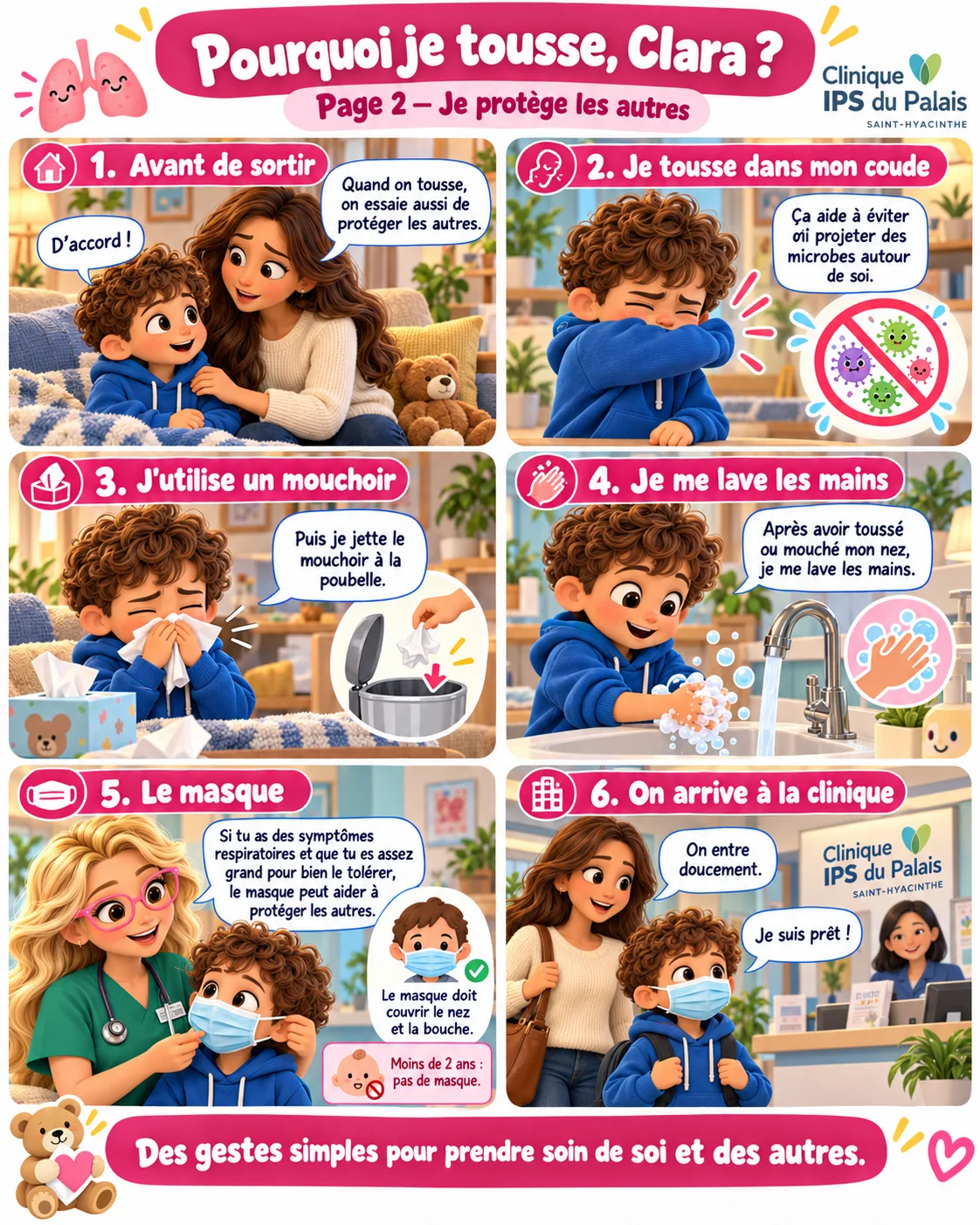
Page 2 — I protect others
1. Before going out
The mother: “When we cough, we also try to protect others.”
The child: “Okay!”
2. I cough into my elbow
“It helps avoid spreading germs around you.”
3. I use a tissue
“Then I throw the tissue in the garbage.”
4. I wash my hands
“After coughing or blowing my nose, I wash my hands.”
5. The mask
Clara: “If you have respiratory symptoms and you're old enough to tolerate it well, a mask can help protect others.”
Key point: the mask must cover the nose and mouth.
Key point: under 2, no mask.
6. Arriving at the clinic
The mother: “Let's go in calmly.”
The child: “I'm ready!”
“Simple gestures to take care of yourself and others.”
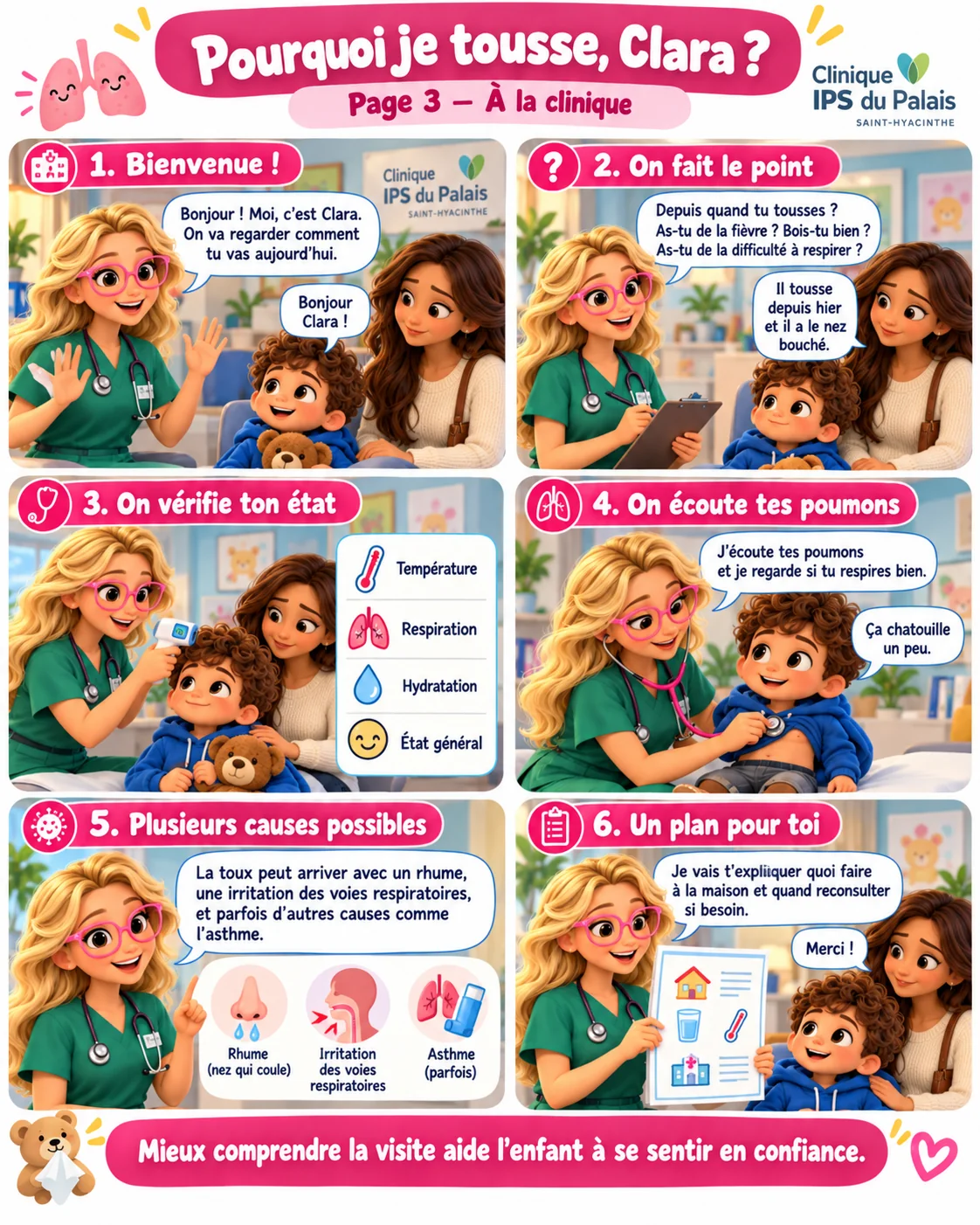
Page 3 — At the clinic
1. Welcome!
Clara: “Hello! I'm Clara. We're going to see how you're doing today.”
The child: “Hi Clara!”
2. Taking stock
Clara: “How long have you been coughing? Do you have a fever? Are you drinking well? Are you having trouble breathing?”
The mother: “He's been coughing since yesterday and his nose is stuffy.”
3. Checking how you are
The board shows: temperature, breathing, hydration, general condition.
4. Listening to your lungs
Clara: “I'm listening to your lungs and checking that you're breathing well.”
The child: “It tickles a little.”
5. Several possible causes
Clara: “A cough can come with a cold, irritated airways, and sometimes other causes like asthma.”
The pictures show: cold (runny nose), irritated airways, asthma (sometimes).
6. A plan for you
Clara: “I'll explain what to do at home and when to come back if needed.”
The mother: “Thank you!”
“Understanding the visit better helps the child feel confident.”
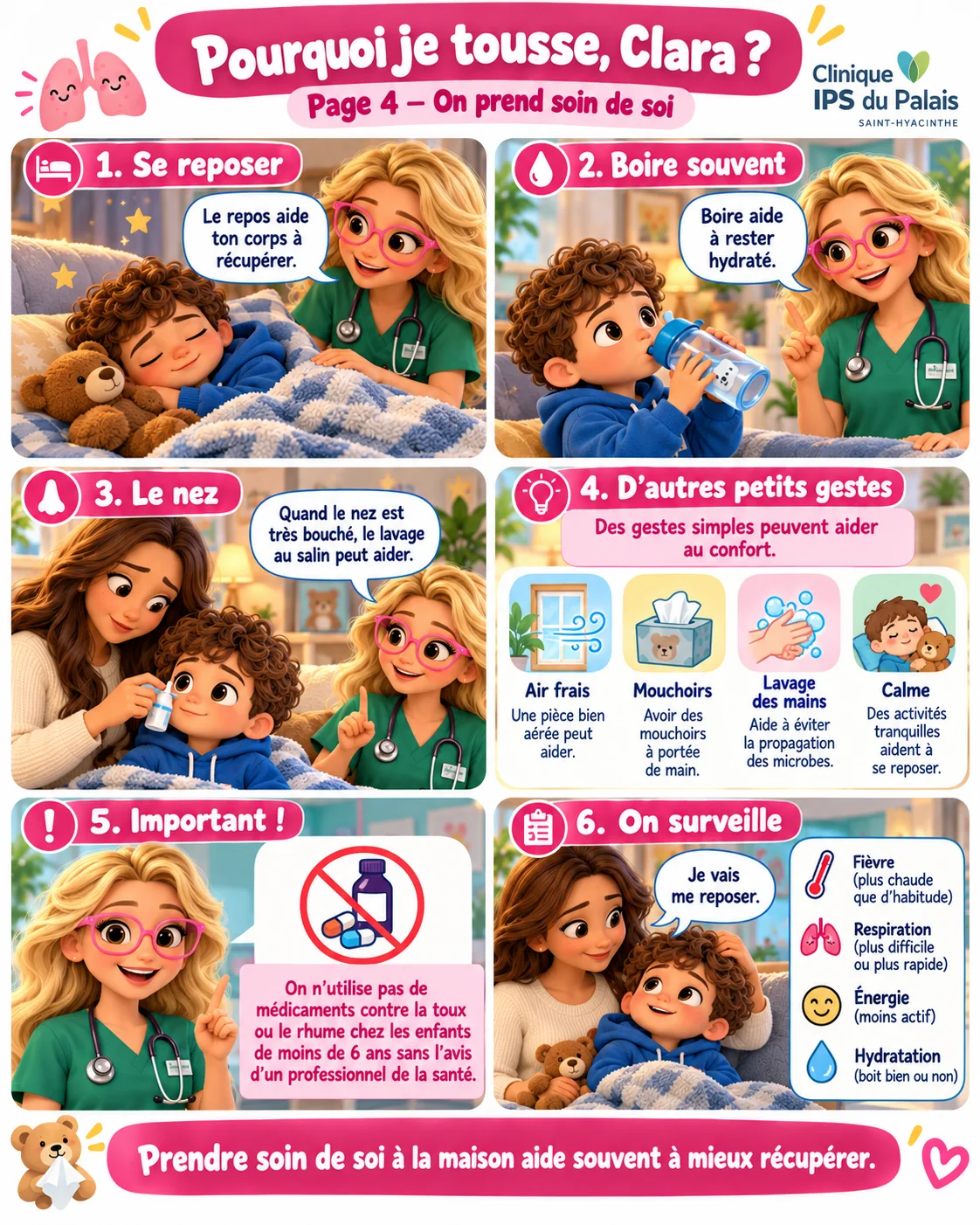
Page 4 — Taking care of yourself
1. Resting
Clara: “Rest helps your body recover.”
2. Drinking often
Clara: “Drinking helps you stay hydrated.”
3. The nose
Clara: “When the nose is very stuffy, a saline rinse can help.”
4. Other little gestures
Simple gestures can help with comfort.
Fresh air: a well-ventilated room can help.
Tissues: keep tissues within reach.
Hand washing: helps prevent the spread of germs.
Calm: quiet activities help you rest.
5. Important!
We don't use cough or cold medicines in children under 6 without the advice of a health professional.
6. Keeping an eye on things
The child: “I'm going to rest.”
The board shows: fever (warmer than usual), breathing (harder or faster), energy (less active), hydration (drinking well or not).
“Taking care of yourself at home often helps you recover better.”
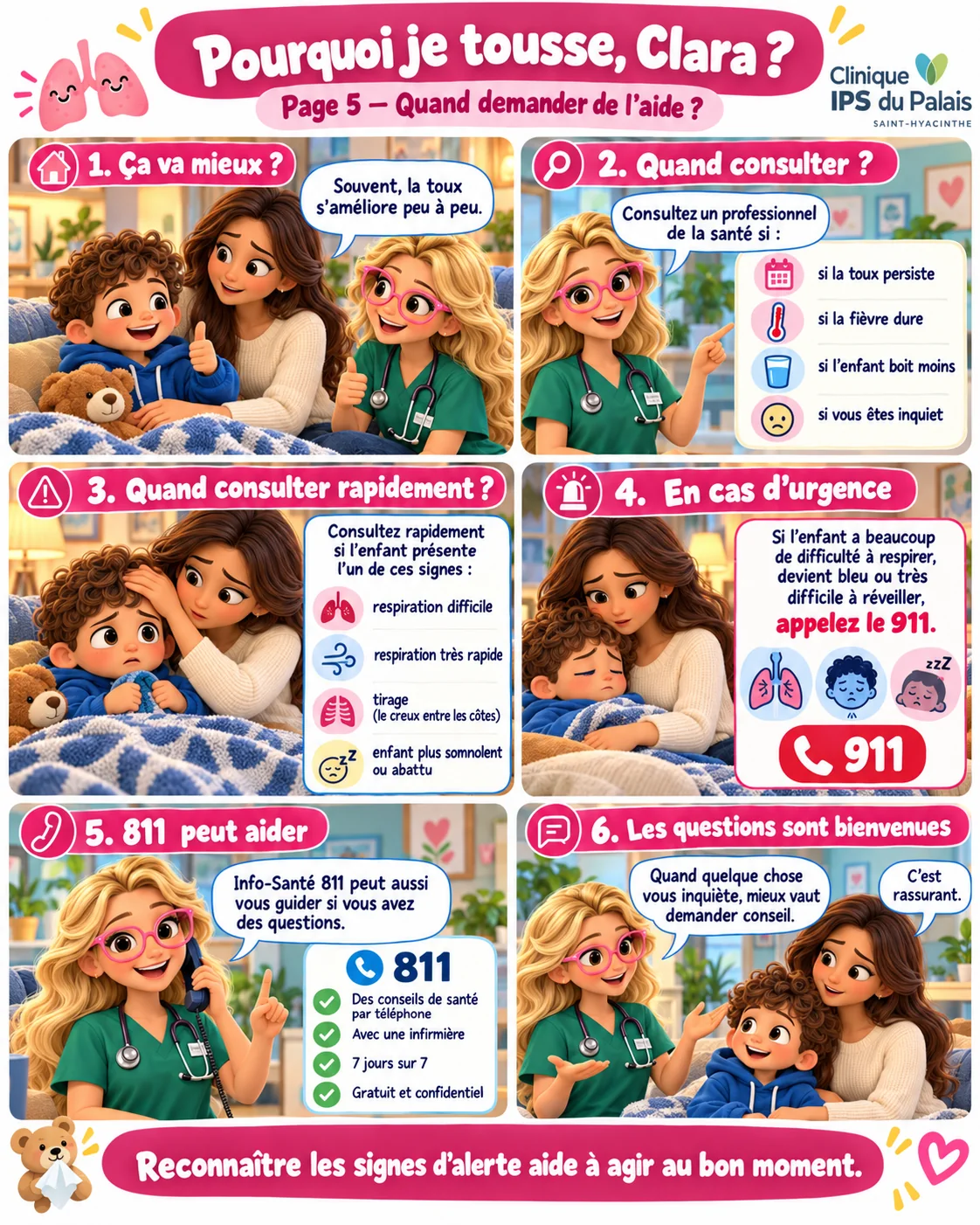
Page 5 — When to ask for help?
1. Feeling better?
“A cough often gets better little by little.”
2. When to see a professional?
Clara: “See a health professional if the cough persists, if the fever lasts, if the child is drinking less or if you're worried.”
3. When to see someone quickly?
See someone quickly if the child shows any of these signs: difficult breathing; very fast breathing; retractions (the skin sinking in between the ribs); the child is drowsier or listless.
4. In an emergency
If the child has a lot of difficulty breathing, turns blue or is very hard to wake up, call 911.
5. 811 can help
Clara: “Info-Santé 811 can also guide you if you have questions.”
The box shows: 811, health advice by phone, with a nurse, 7 days a week, free and confidential.
6. Questions are welcome
Clara: “When something worries you, it's best to ask for advice.”
The mother: “That's reassuring.”
“Recognizing warning signs helps you act at the right time.”
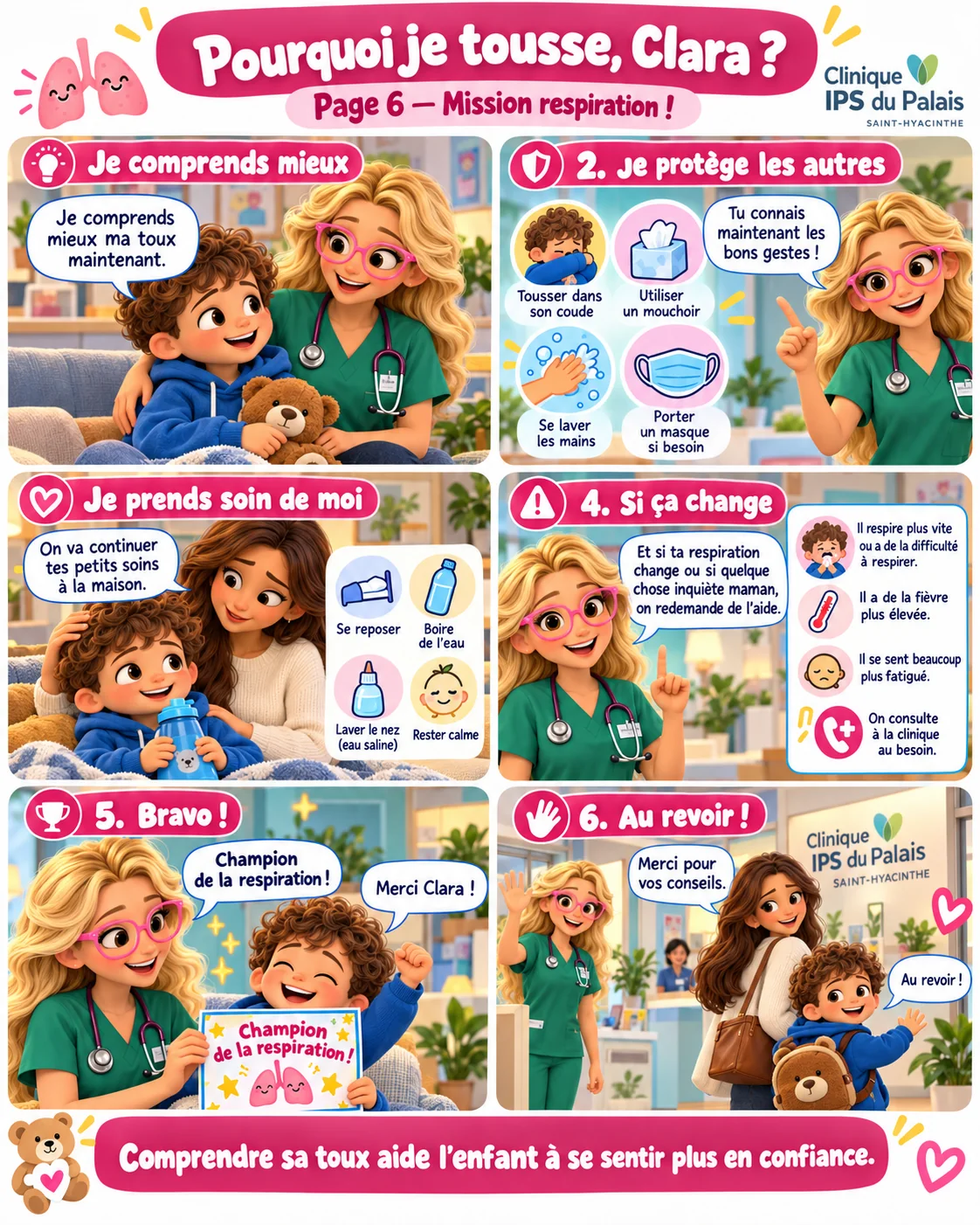
Page 6 — Mission breathing!
1. I understand better
The child: “I understand my cough better now.”
2. I protect others
Clara: “Now you know the right gestures!”
The pictures show: coughing into your elbow, using a tissue, washing your hands, wearing a mask if needed.
3. I take care of myself
The mother: “We'll keep up your little home care routine.”
The pictures show: resting, drinking water, rinsing the nose (saline water), staying calm.
4. If things change
Clara: “And if your breathing changes or something worries your mom, we ask for help again.”
The board shows: he breathes faster or has trouble breathing; he has a higher fever; he feels much more tired; we see the clinic if needed.
5. Well done!
Clara: “Breathing champion!”
The child: “Thank you, Clara!”
The child holds a diploma: “Breathing champion!”
6. Goodbye!
The mother: “Thank you for your advice.”
The child: “Goodbye!”
“Understanding their cough helps children feel more confident.”
For parents: good to know
At home: clean the nose if there are secretions and make sure the child drinks enough. Do not give cough and cold medicines (syrup, suppository or other) to children under 6: according to Health Canada, they are not effective and can be dangerous.
See a professional if the child coughs a lot and is under 3 months old, coughs to the point of choking or vomiting, or has been coughing for more than 10 days. See someone quickly if the child has difficulty breathing or breathes with effort, has retractions, or has wheezing, noisy or fast breathing.
Call 911 if the situation seems serious and urgent. Info-Santé 811 lets you reach a nurse 24 hours a day; the service is free and confidential.
Sources (in French): Institut national de santé publique du Québec (INSPQ), Toux chez l’enfant (updated February 17, 2026) and Service Info-Santé. Consulted on October 10, 2026.
“Understanding the care often helps children feel more confident.”
For parents: good to know
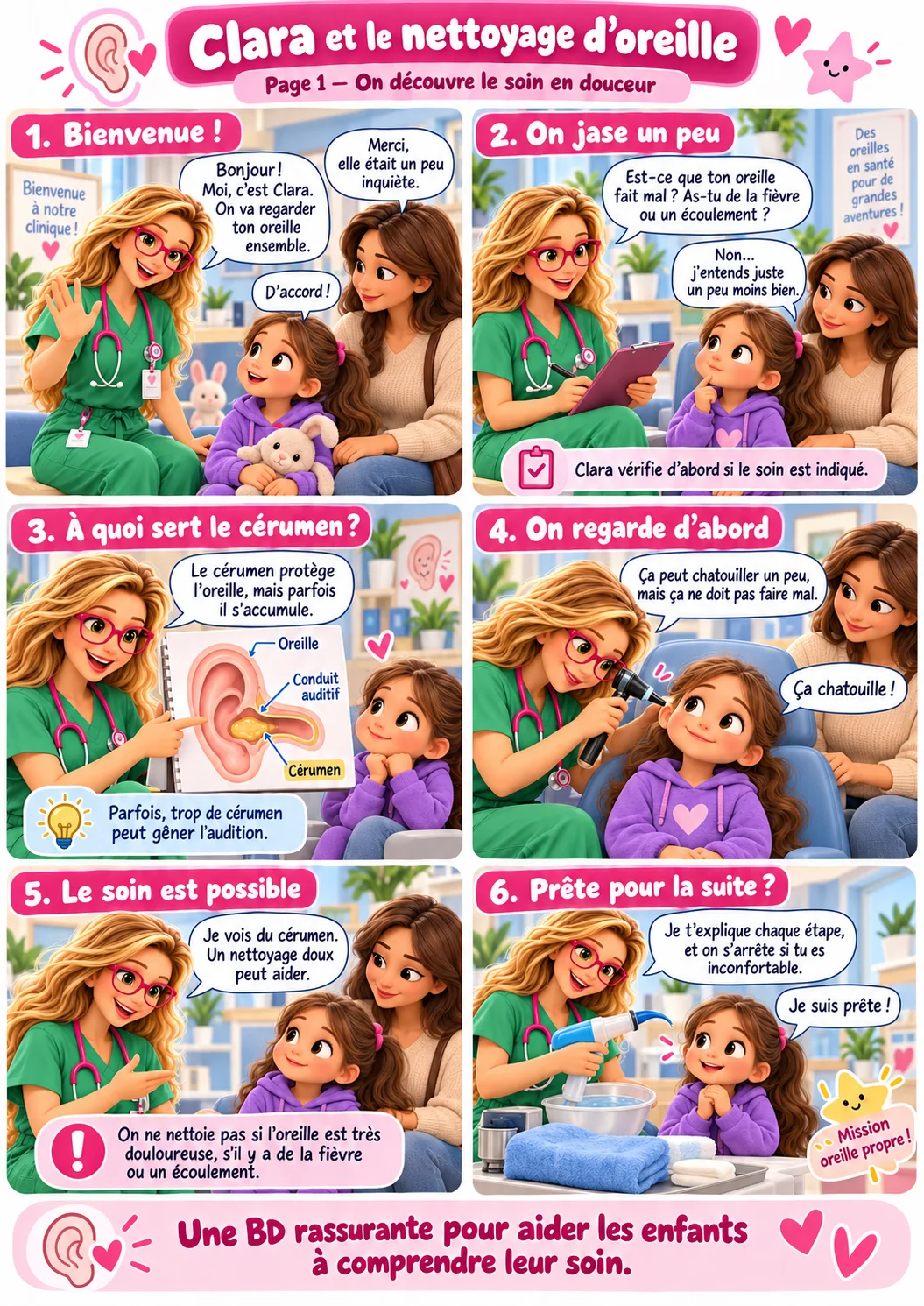
Before the irrigation, the nurse examines the ear to check for an earwax plug and make sure the care can be done safely.
If there is significant pain, fever, discharge, tubes in the ears or a known perforated eardrum, contact our team before booking.
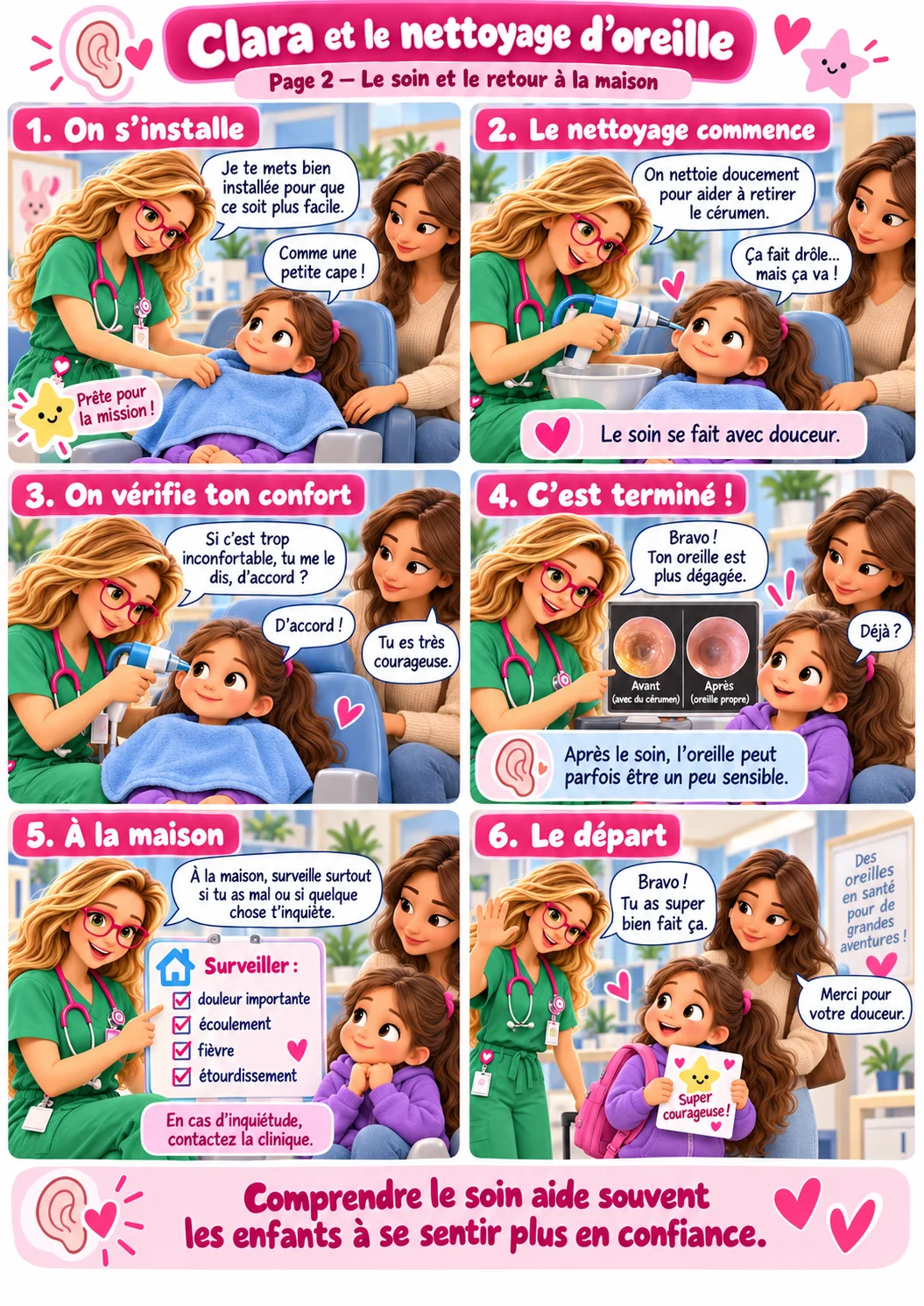
After the care, the ear can sometimes be a little sensitive. Contact the clinic in case of significant pain, discharge, fever, dizziness or any other concern.
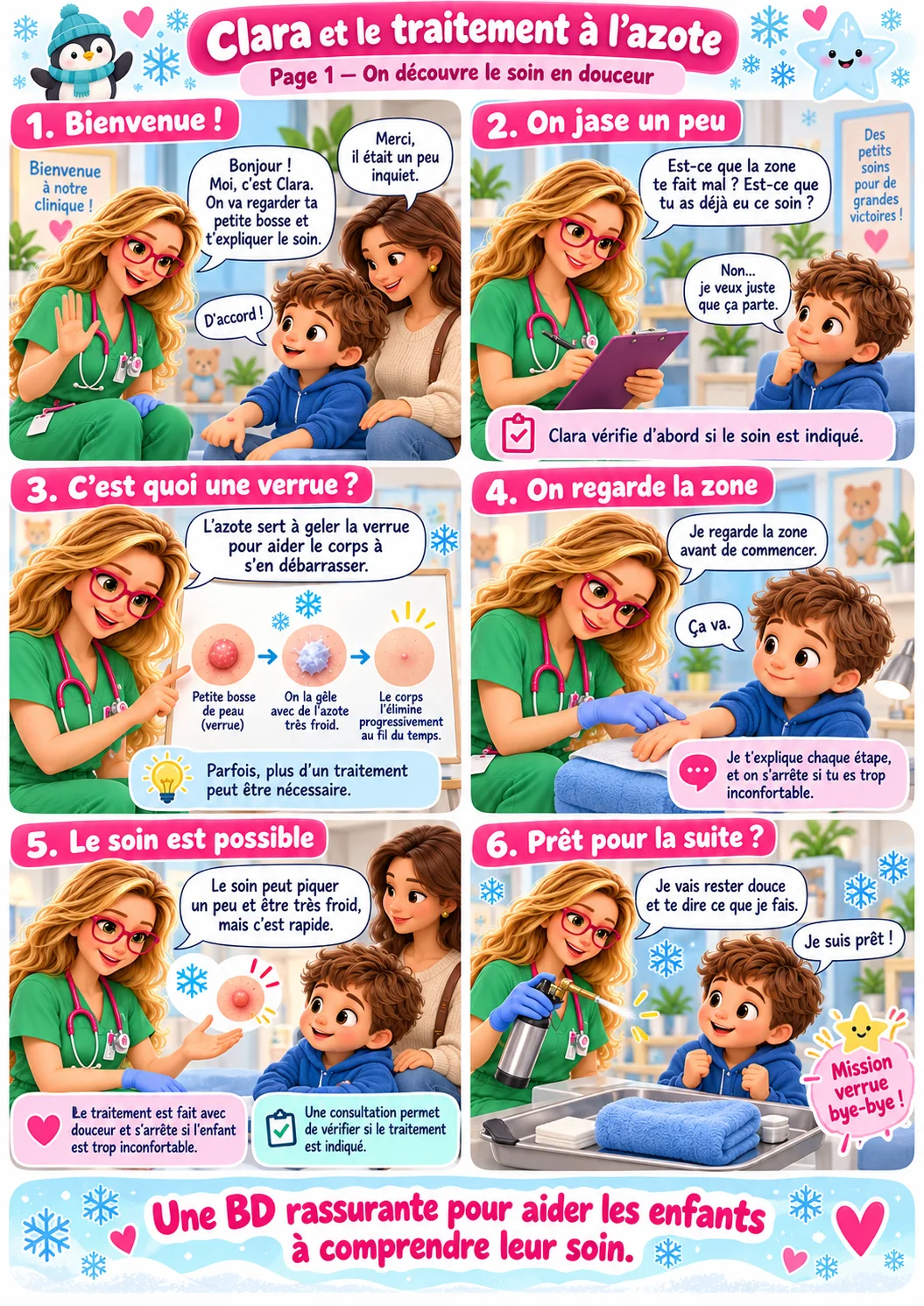
A reassuring comic to help children understand how a wart is treated with cold. The comic pages are in French; the full text is available in English below.
Page 1 Discovering the care, gentlyEnlarge page 1Page 2 The care and going homeEnlarge page 2Read the comic text in English
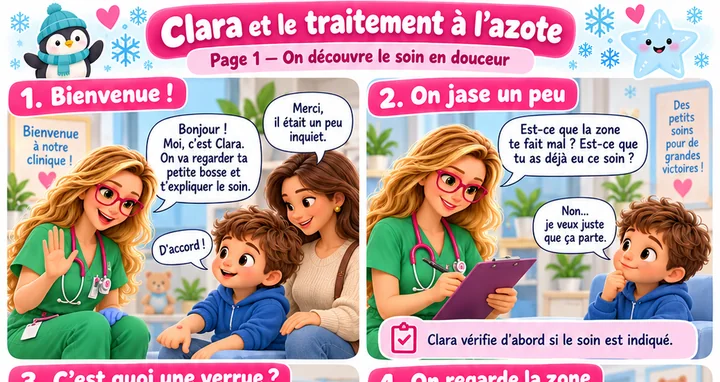
Page 1 — Discovering the care, gently
1. Welcome!
On the poster: “Welcome to our clinic!”
Clara: “Hello! I'm Clara. We're going to look at your little bump and I'll explain the care.”
The mother: “Thank you, he was a little worried.”
The child: “Okay!”
2. Let's chat a little
Clara: “Does the area hurt? Have you ever had this care before?”
The child: “No… I just want it to go away.”
On the poster: “Little care for big victories!”
Key point: Clara first checks whether the care is appropriate.
3. What is a wart?
Clara: “Nitrogen is used to freeze the wart to help the body get rid of it.”
The drawing shows three steps: a little bump on the skin (wart), we freeze it with very cold nitrogen, then the body gradually gets rid of it over time.
Key point: sometimes more than one treatment may be needed.
4. Looking at the area
Clara: “I'm looking at the area before we start.”
The child: “I'm okay.”
Clara: “I'll explain every step, and we'll stop if you're too uncomfortable.”
5. The care is possible
Clara: “The care may sting a little and feel very cold, but it's quick.”
Key point: the treatment is done gently and stops if the child is too uncomfortable.
Key point: a consultation is used to check whether the treatment is appropriate.
6. Ready for what's next?
Clara: “I'll stay gentle and tell you what I'm doing.”
The child: “I'm ready!”
A little star: “Mission bye-bye wart!”
“A reassuring comic to help children understand their care.”
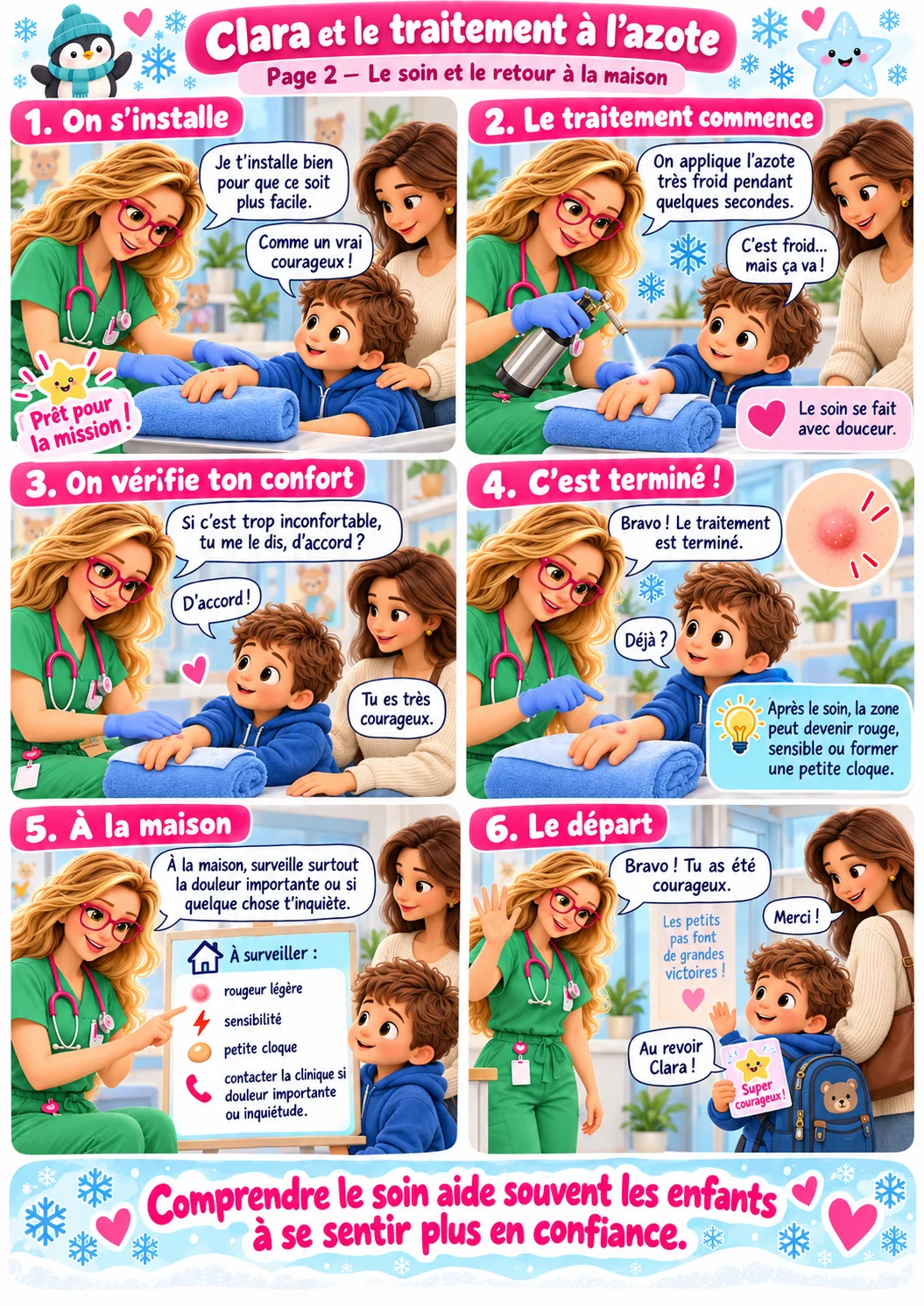
Page 2 — The care and going home
1. Getting settled
Clara: “I'm getting you nice and comfy so it's easier.”
The child: “Like a real brave kid!”
A little star: “Ready for the mission!”
2. The treatment begins
Clara: “We apply the very cold nitrogen for a few seconds.”
The child: “It's cold… but it's okay!”
Key point: the care is done gently.
3. Checking that you're comfortable
Clara: “If it's too uncomfortable, you tell me, okay?”
The child: “Okay!”
The mother: “You're very brave.”
4. All done!
Clara: “Well done! The treatment is finished.”
The child: “Already?”
Key point: after the care, the area may turn red, feel sensitive or form a small blister.
5. At home
Clara: “At home, watch especially for significant pain or anything that worries you.”
Watch for: mild redness, sensitivity, small blister.
Contact the clinic if there is significant pain or any concern.
6. Time to go
Clara: “Well done! You were brave.”
The mother: “Thank you!”
The child: “Goodbye, Clara!”
The child holds a card that says “Super brave!”
On the poster: “Little steps make big victories!”
“Understanding the care often helps children feel more confident.”
For parents: good to know
A consultation with a nurse practitioner (NP) is required before a liquid nitrogen treatment, unless you have a valid prescription from an authorized professional. The NP checks that the lesion can be treated this way.
During the application, a burning sensation is usual. Afterwards, redness, swelling or a blister may appear, and several sessions are sometimes needed.
Contact the clinic if, after 48 hours, the treated area becomes increasingly red, swollen or painful, or if fluid drains from it after 24 hours.
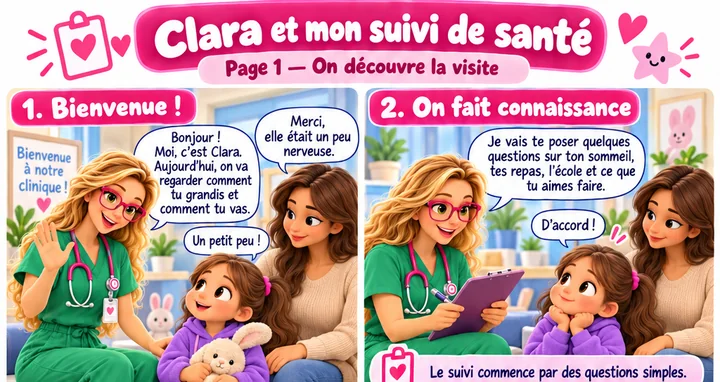
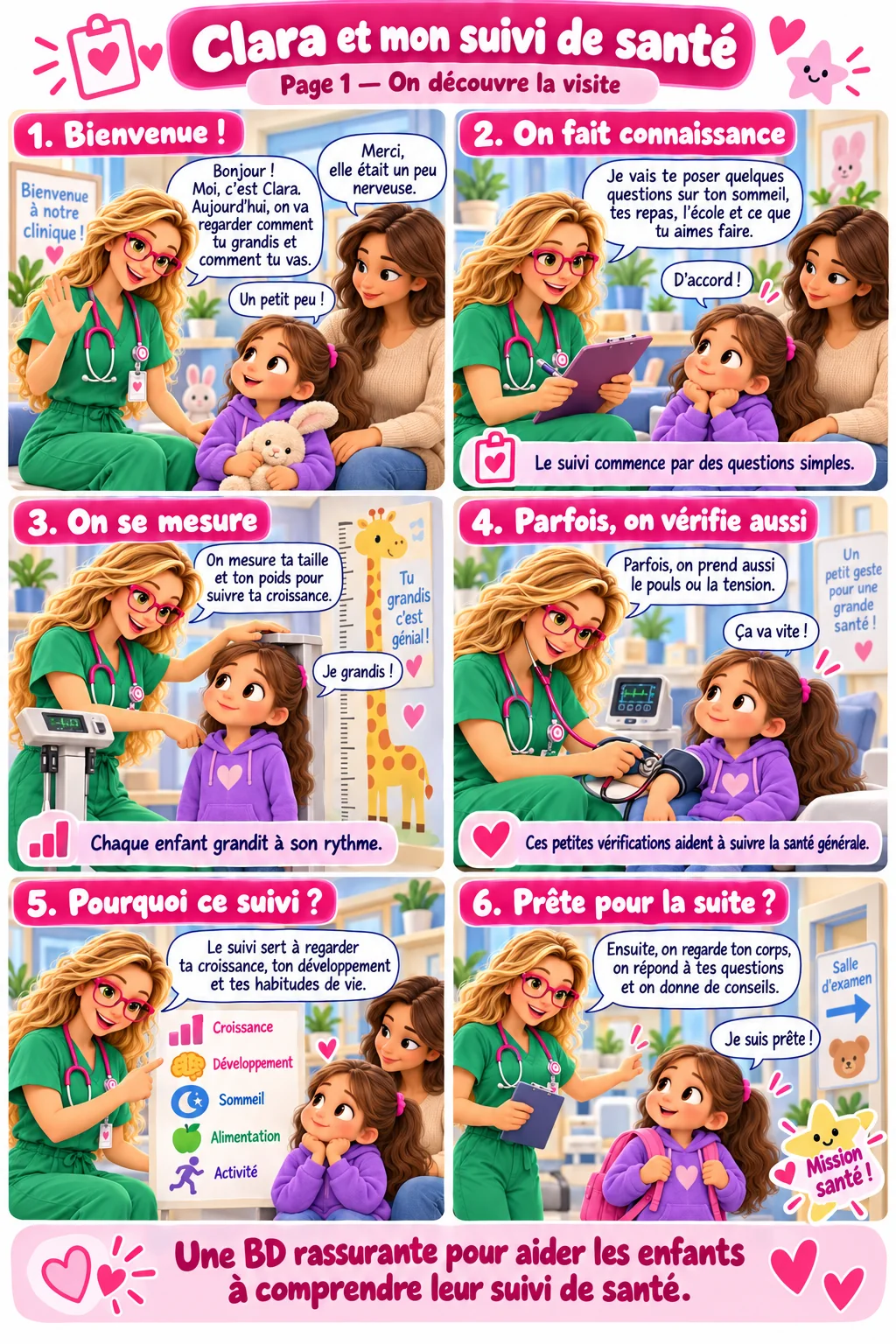
A reassuring comic to help children understand their health check-up, from arrival to departure. The comic pages are in French; the full text is available in English below.
Clara: “Hello! I'm Clara. Today, we're going to look at how you're growing and how you're doing.”
The mother: “Thank you, she was a little nervous.”
The child: “Just a little!”
2. Getting to know each other
Clara: “I'm going to ask you a few questions about your sleep, your meals, school and what you like to do.”
The child: “Okay!”
Key point: the check-up starts with simple questions.
3. Taking measurements
Clara: “We measure your height and weight to follow your growth.”
The child: “I'm growing!”
On the poster: “You're growing, that's great!”
Key point: every child grows at their own pace.
4. Sometimes we check a bit more
Clara: “Sometimes we also take your pulse or blood pressure.”
The child: “That was quick!”
On the poster: “A small gesture for great health!”
Key point: these small checks help follow overall health.
5. Why this check-up?
Clara: “The check-up is for looking at your growth, your development and your lifestyle habits.”
The board shows: growth, development, sleep, nutrition, activity.
6. Ready for what's next?
Clara: “Next, we look at your body, answer your questions and give you some advice.”
The child: “I'm ready!”
A little star: “Mission health!”
“A reassuring comic to help children understand their health check-up.”
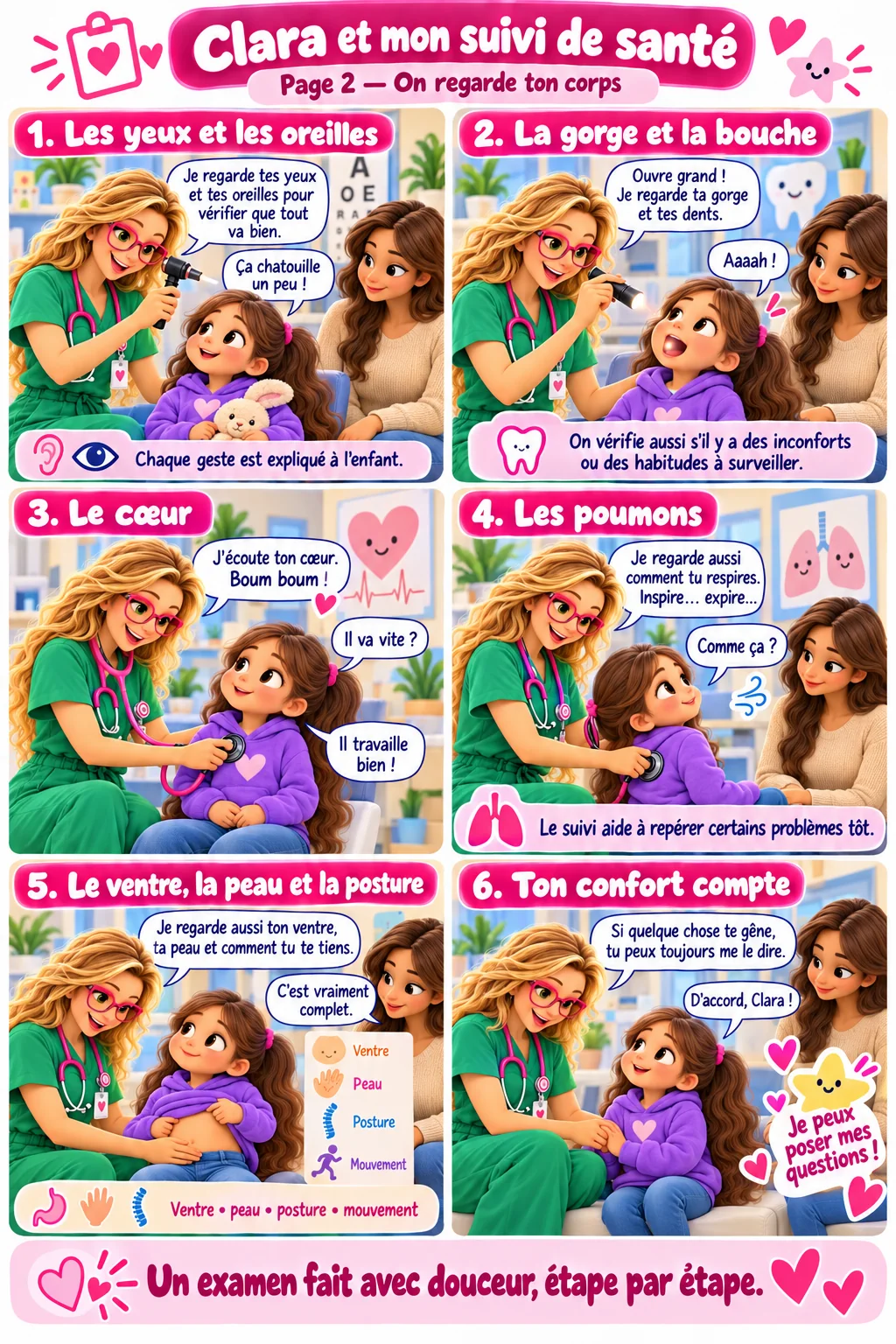
Page 2 — Looking at your body
1. Eyes and ears
Clara: “I'm looking at your eyes and ears to check that everything is fine.”
The child: “It tickles a little!”
Key point: each step is explained to the child.
2. Throat and mouth
Clara: “Open wide! I'm looking at your throat and teeth.”
The child: “Aaaah!”
Key point: we also check for any discomfort or habits to keep an eye on.
3. The heart
Clara: “I'm listening to your heart. Thump thump!”
The child: “Is it going fast?”
Clara: “It's working well!”
4. The lungs
Clara: “I'm also checking how you breathe. Breathe in… breathe out…”
The child: “Like this?”
Key point: the check-up helps catch some problems early.
5. Belly, skin and posture
Clara: “I'm also looking at your belly, your skin and how you stand.”
The mother: “It's really thorough.”
The board shows: belly, skin, posture, movement.
6. Your comfort matters
Clara: “If something bothers you, you can always tell me.”
The child: “Okay, Clara!”
A little star: “I can ask my questions!”
“An exam done gently, step by step.”
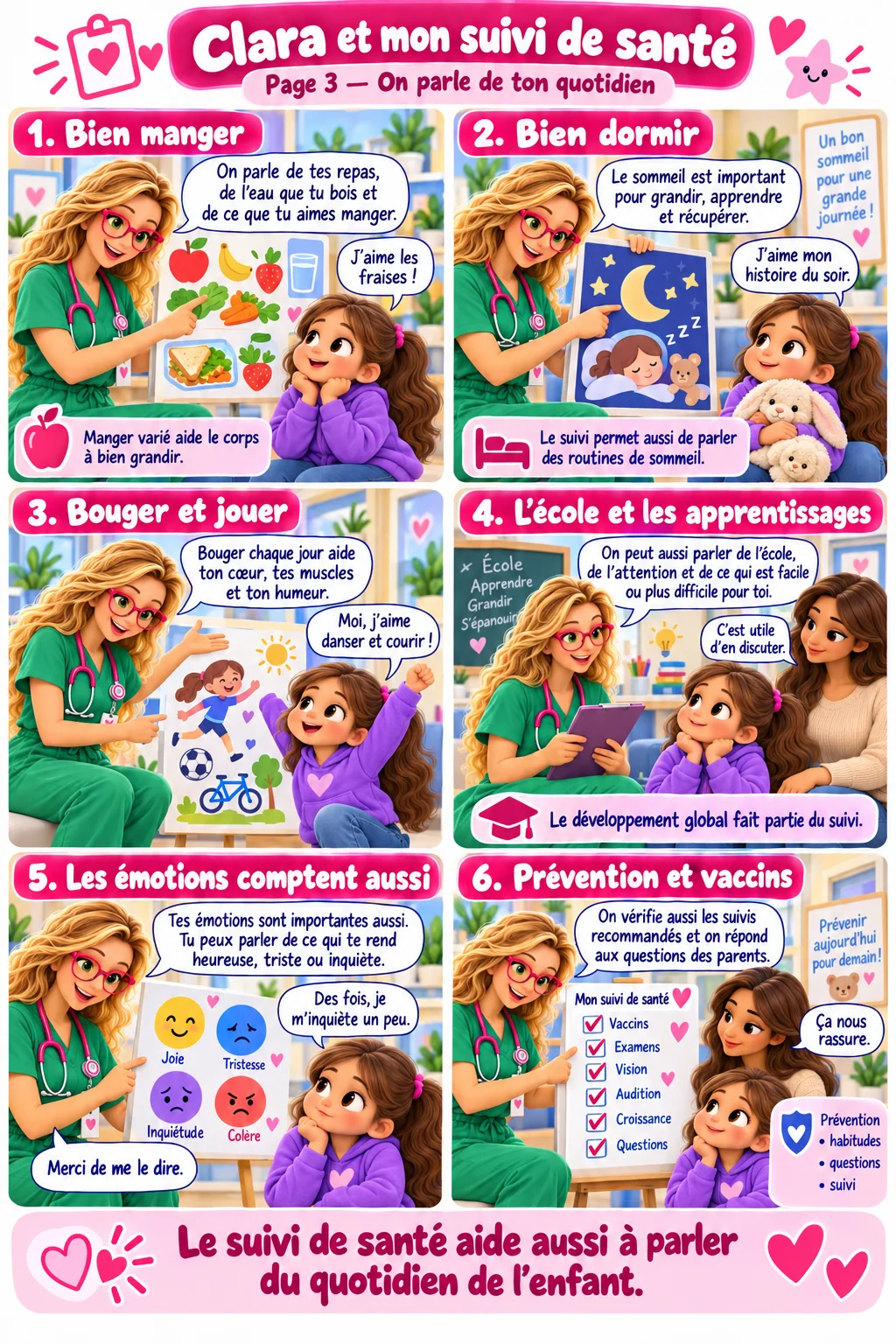
Page 3 — Talking about your daily life
1. Eating well
Clara: “Let's talk about your meals, the water you drink and what you like to eat.”
The child: “I like strawberries!”
Key point: eating a variety of foods helps the body grow well.
2. Sleeping well
Clara: “Sleep is important for growing, learning and recovering.”
The child: “I like my bedtime story.”
On the poster: “Good sleep for a great day!”
Key point: the check-up is also a chance to talk about sleep routines.
3. Moving and playing
Clara: “Moving every day helps your heart, your muscles and your mood.”
The child: “I love dancing and running!”
4. School and learning
Clara: “We can also talk about school, attention and what's easy or harder for you.”
The mother: “It's helpful to talk about it.”
Key point: overall development is part of the check-up.
5. Emotions matter too
Clara: “Your feelings are important too. You can talk about what makes you happy, sad or worried.”
The child: “Sometimes I worry a little.”
Clara: “Thank you for telling me.”
The board shows: joy, sadness, worry, anger.
6. Prevention and vaccines
Clara: “We also check the recommended follow-ups and answer the parents' questions.”
The mother: “That reassures us.”
The “My health check-up” board shows: vaccines, exams, vision, hearing, growth, questions.
Prevention: habits, questions, follow-up.
On the poster: “Prevent today for tomorrow!”
“The health check-up is also a chance to talk about the child's daily life.”
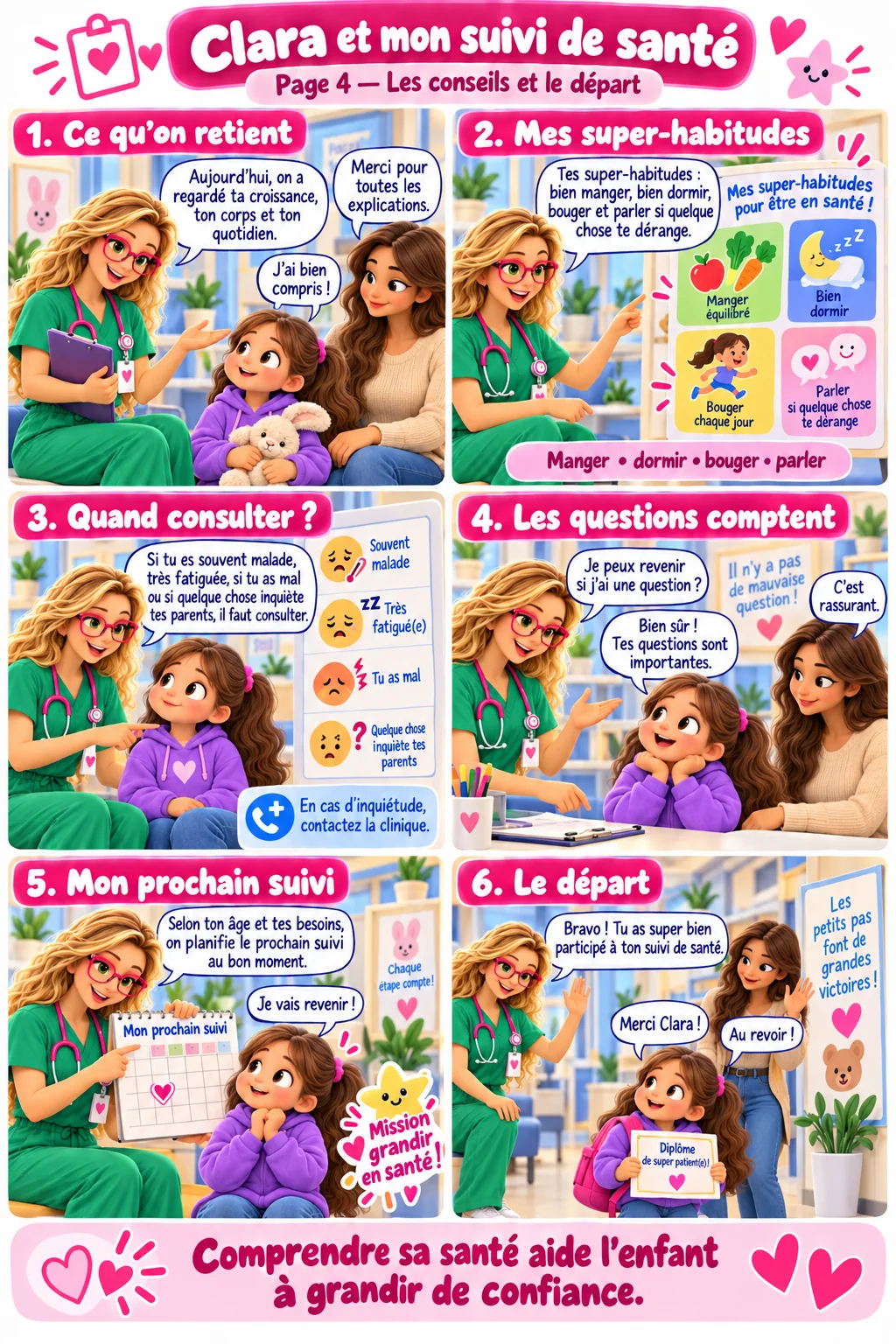
Page 4 — Advice and time to go
1. What we remember
Clara: “Today, we looked at your growth, your body and your daily life.”
The mother: “Thank you for all the explanations.”
The child: “I understood!”
2. My super-habits
Clara: “Your super-habits: eat well, sleep well, move and speak up if something bothers you.”
The poster “My super-habits for staying healthy!” shows: balanced eating, sleeping well, moving every day, speaking up if something bothers you.
Key point: eat, sleep, move, speak up.
3. When to see a professional?
Clara: “If you're often sick, very tired, in pain or if something worries your parents, you need to see a professional.”
The board shows: often sick, very tired, in pain, something worries your parents.
If you are worried, contact the clinic.
4. Questions matter
The child: “Can I come back if I have a question?”
Clara: “Of course! Your questions are important.”
The mother: “That's reassuring.”
On the poster: “There's no such thing as a bad question!”
5. My next check-up
Clara: “Depending on your age and needs, we'll plan your next check-up at the right time.”
The child: “I'll come back!”
On the poster: “Every step counts!”
A little star: “Mission grow up healthy!”
6. Time to go
Clara: “Well done! You did a great job at your health check-up.”
The child: “Thank you, Clara!”
The mother: “Goodbye!”
The child holds a “Super patient diploma”.
On the poster: “Little steps make big victories!”
“Understanding their health helps children grow up with confidence.”
For parents: good to know
The pediatric health assessment is a preventive consultation, even when the child is well: growth, development, an age-appropriate physical exam, lifestyle habits and vaccination.
The professional may check the vaccination record. An assessment does not automatically mean a vaccine will be given during the consultation: arrangements must be confirmed with the clinic or the vaccination services.
Don't wait for the next assessment if you are concerned, for example about the loss of skills already acquired or new or prolonged symptoms. A preventive assessment does not replace an urgent consultation: Info-Santé 811 (option 1) for a nurse's advice, 911 in case of serious distress.
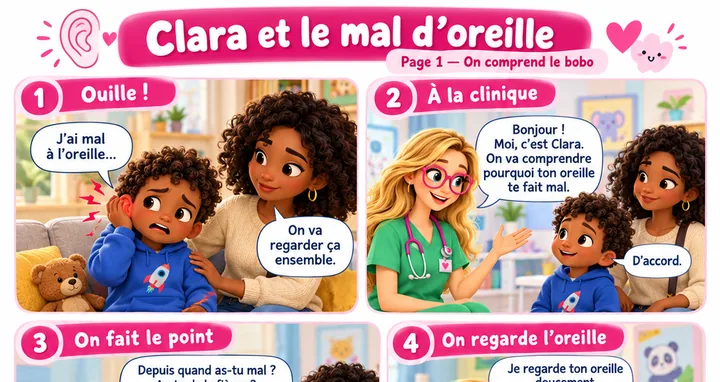
A comic to explain to children what happens when an ear hurts: we look, we understand, then we treat and watch.
Page 1 Understanding the boo-booEnlarge page 1Page 2 Treating and watchingEnlarge page 2Read the comic text in English
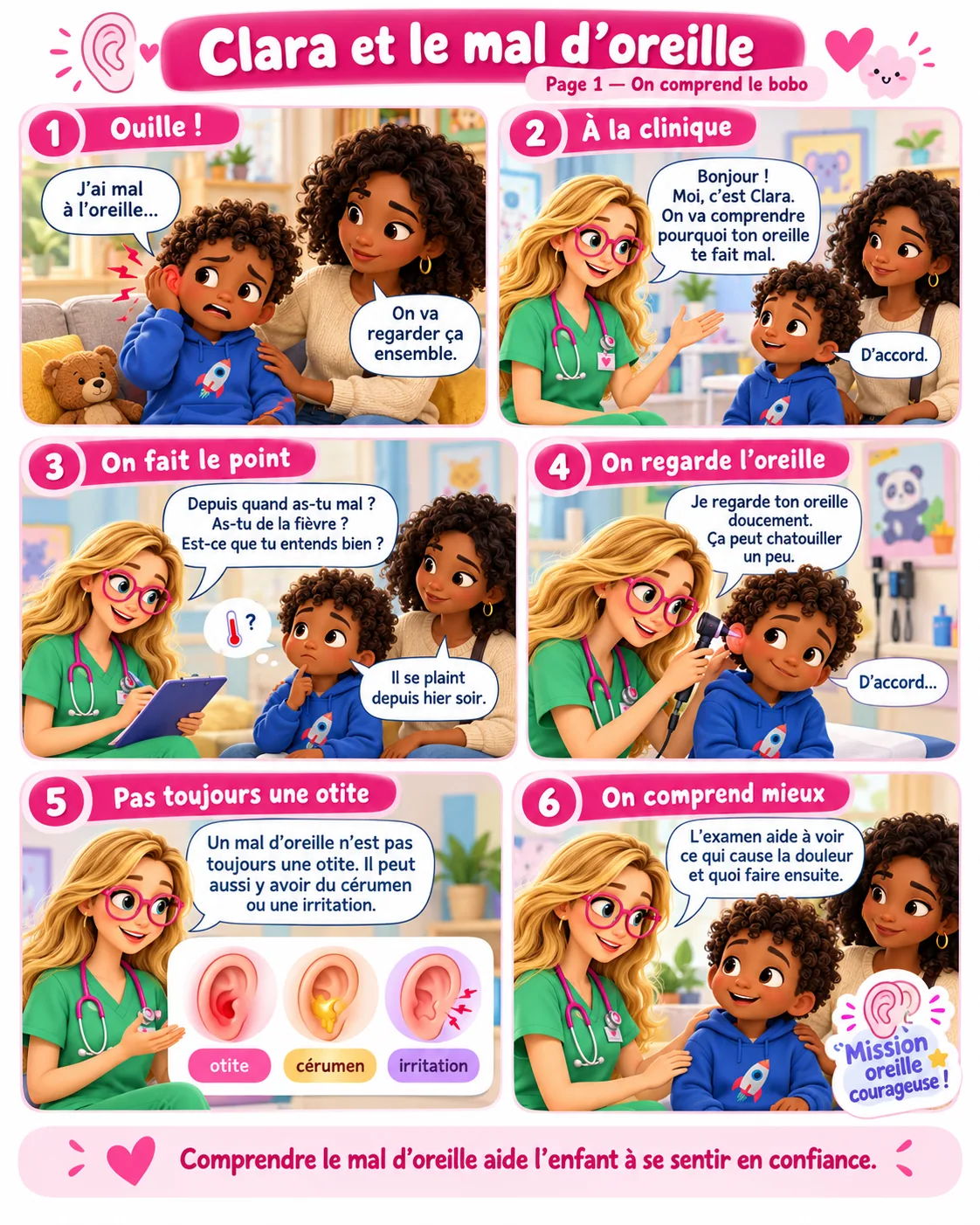
Page 1 — Understanding the boo-boo
1. Ouch!
The child: “My ear hurts…”
The mother: “We'll look at it together.”
2. At the clinic
Clara: “Hello! I'm Clara. We're going to find out why your ear hurts.”
The child: “Okay.”
3. Taking stock
Clara: “How long has it hurt? Do you have a fever? Can you hear well?”
The mother: “He's been complaining since last night.”
4. Looking in the ear
Clara: “I'm going to look in your ear gently. It may tickle a little.”
The child: “Okay…”
5. Not always an ear infection
Clara: “An earache isn't always an ear infection. It can also be earwax or irritation.”
The pictures show: ear infection, earwax, irritation.
6. Now we understand
Clara: “The examination helps us see what is causing the pain and what to do next.”
A sticker says: “Brave ear mission!”
“Understanding an earache helps children feel confident.”
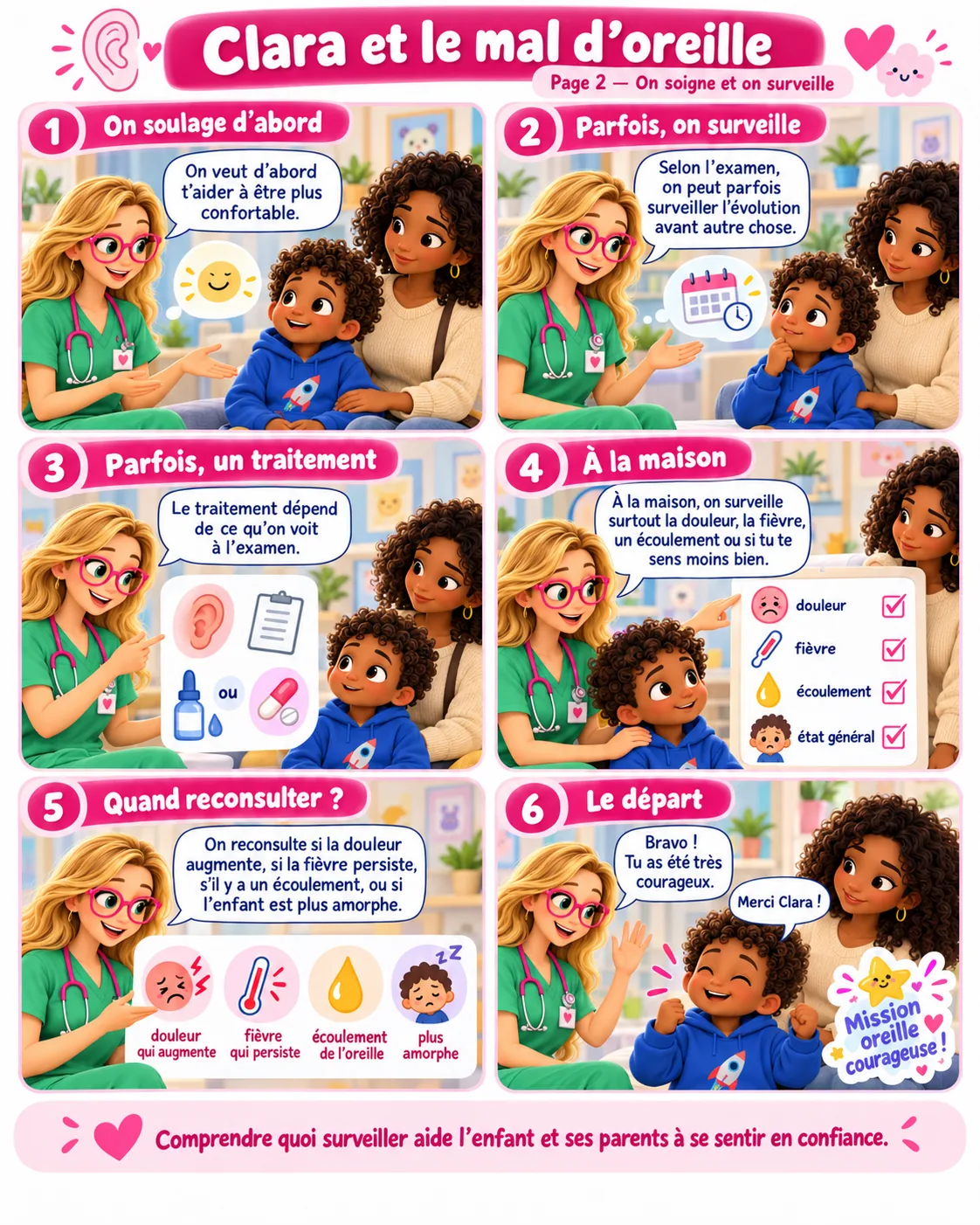
Page 2 — Treating and watching
1. Relief first
Clara: “First, we want to help you feel more comfortable.”
2. Sometimes, we watch and wait
Clara: “Depending on the examination, we can sometimes watch how things go before doing anything else.”
3. Sometimes, a treatment
Clara: “The treatment depends on what we see during the examination.”
The pictures show: drops or a medication.
4. At home
Clara: “At home, we mainly watch for pain, fever, discharge or if you feel less well.”
The board shows: pain, fever, discharge, general condition.
5. When to come back?
Clara: “Come back if the pain gets worse, if the fever persists, if there is discharge, or if the child is more listless.”
6. Time to go
Clara: “Well done! You were very brave.”
The child: “Thank you, Clara!”
“Knowing what to watch for helps children and their parents feel confident.”
For parents: good to know
Most ear infections follow a cold. An ear infection does not always need medical treatment, and an antibiotic is not always necessary: if the child is doing relatively well, the health professional may suggest waiting 24 to 48 hours while watching.
For pain, acetaminophen or ibuprofen can help. Before 6 months of age, talk to a health professional first.
See a health professional if the child is crying a lot, if the ear is draining or if you have the impression that the child is in pain. Also consult if the fever has lasted more than 48 hours, if the child vomits repeatedly, is very drowsy or irritable, still has pain after 2 days of pain treatment, or seems to hear less well a few weeks after an ear infection.
Call 911 if the situation seems serious and urgent. Info-Santé 811 lets you reach a nurse 24 hours a day; the service is free and confidential.
Sources (in French): Institut national de santé publique du Québec (INSPQ), Mal d’oreille (otite) chez l’enfant (updated February 17, 2026); Canadian Paediatric Society, L’otite (updated March 2022); INSPQ, Service Info-Santé. Consulted on October 10, 2026.
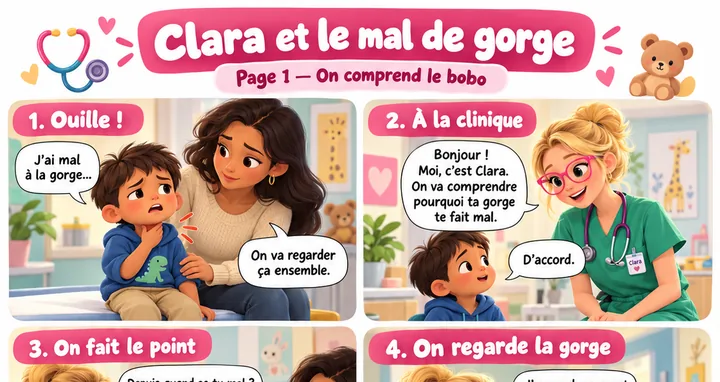
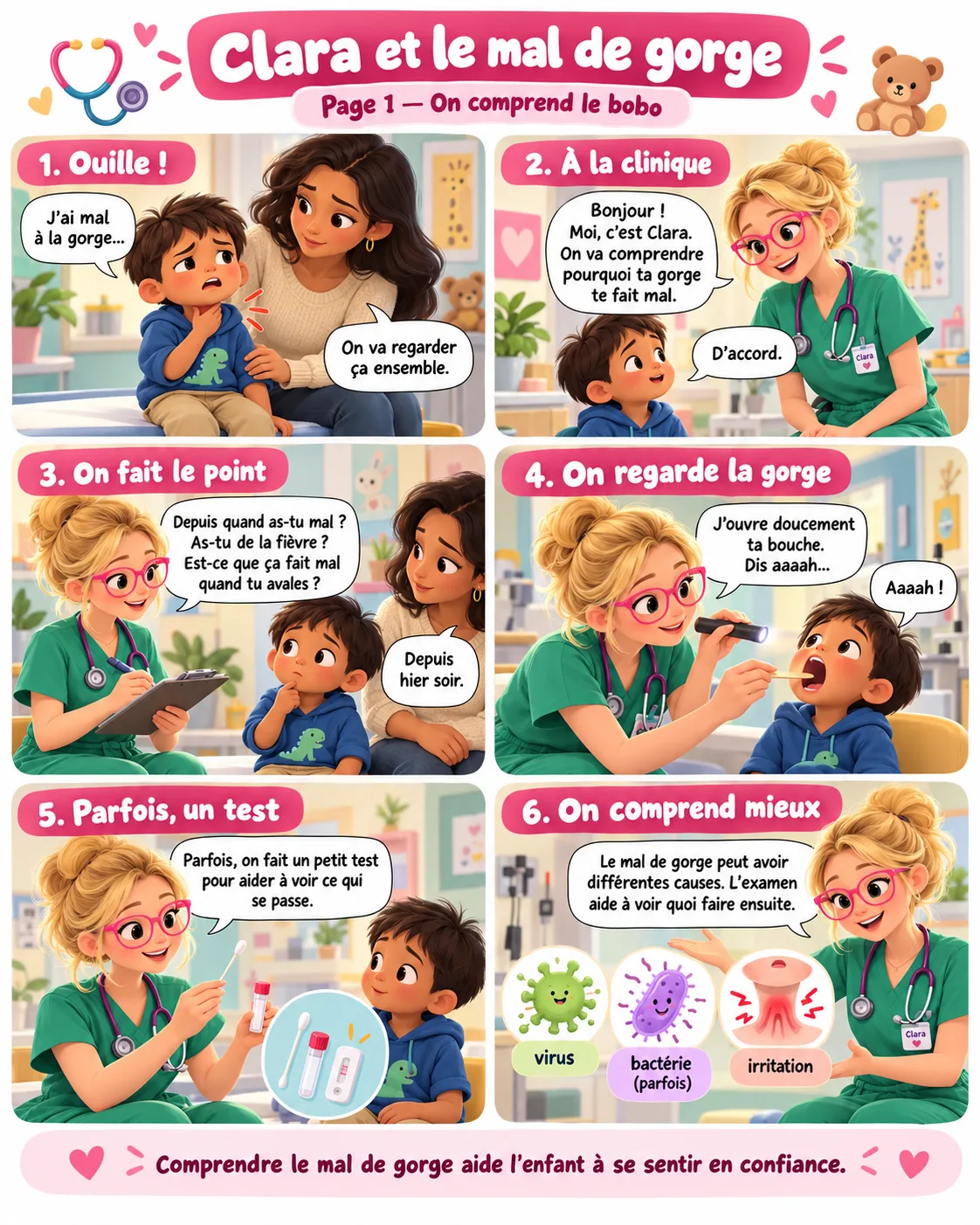
A comic to explain to children what happens when the throat hurts: we look, we sometimes do a small test, then we treat and watch.
Page 1 Understanding the boo-booEnlarge page 1Page 2 Treating and watchingEnlarge page 2Read the comic text in English
Page 1 — Understanding the boo-boo
1. Ouch!
The child: “My throat hurts…”
The mother: “We'll look at it together.”
2. At the clinic
Clara: “Hello! I'm Clara. We're going to find out why your throat hurts.”
The child: “Okay.”
3. Taking stock
Clara: “How long has it hurt? Do you have a fever? Does it hurt when you swallow?”
The mother: “Since last night.”
4. Looking at the throat
Clara: “I'm gently opening your mouth. Say aaaah…”
The child: “Aaaah!”
5. Sometimes, a test
Clara: “Sometimes we do a small test to help see what's going on.”
6. Now we understand
Clara: “A sore throat can have different causes. The examination helps us see what to do next.”
The pictures show: virus, bacteria (sometimes), irritation.
“Understanding a sore throat helps children feel confident.”
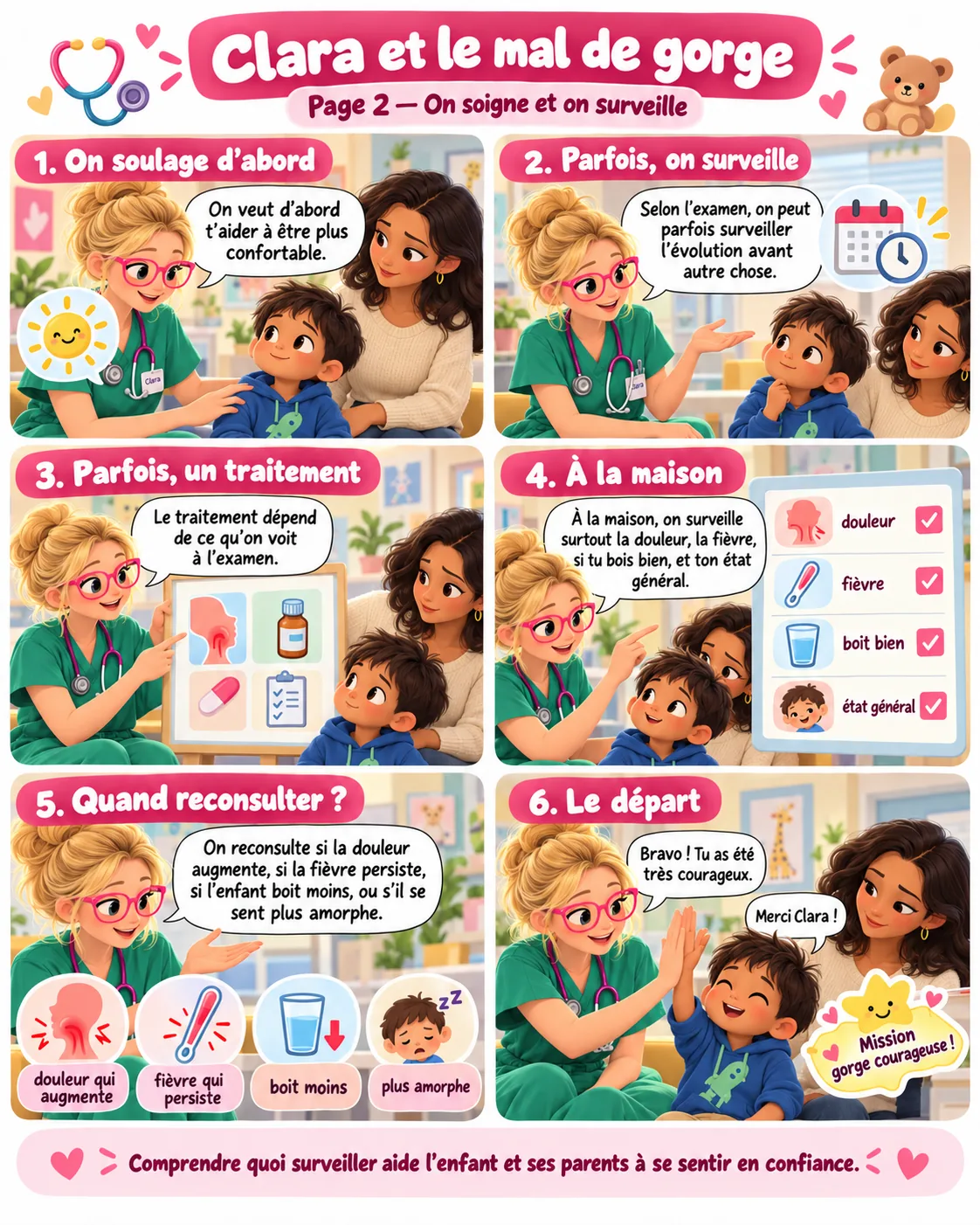
Page 2 — Treating and watching
1. Relief first
Clara: “First, we want to help you feel more comfortable.”
2. Sometimes, we watch and wait
Clara: “Depending on the examination, we can sometimes watch how things go before doing anything else.”
3. Sometimes, a treatment
Clara: “The treatment depends on what we see during the examination.”
4. At home
Clara: “At home, we mainly watch for pain, fever, whether you are drinking well, and how you feel overall.”
The board shows: pain, fever, drinking well, general condition.
5. When to come back?
Clara: “Come back if the pain gets worse, if the fever persists, if the child drinks less, or if they feel more listless.”
6. Time to go
Clara: “Well done! You were very brave.”
The child: “Thank you, Clara!”
A sticker says: “Brave throat mission!”
“Knowing what to watch for helps children and their parents feel confident.”
For parents: good to know
A sore throat is most often caused by viruses, such as cold viruses; antibiotics do not help in that case. Sometimes a bacterium such as streptococcus is the cause: a throat test helps confirm it, and an antibiotic may then be prescribed.
At home: offer drinks often (a straw or a sippy cup can help); cold foods are often better accepted. Acetaminophen can help, and ibuprofen can be given from 6 months of age. Avoid lozenges for children aged 4 and under, and honey before 1 year of age.
See a health professional if the child has difficulty breathing or swallowing, or if the symptoms get worse. A throat infection caused by a virus usually lasts less than a week.
Call 911 if the situation seems serious and urgent. Info-Santé 811 lets you reach a nurse 24 hours a day; the service is free and confidential.
In the comics, Clara puts on her scrubs to tell the story of the care. In real life, Clara is the website's virtual assistant: the clinic's nurses and health professionals are the ones who provide care. Clara is here to guide you around the website!
For parents
Reading the comic with your child
A few ideas to make it a gentle moment before the appointment.
Read before the appointment
Take the time to read the comic together a few days or a few hours before the care, then read it again as needed.
Look at the pictures
Point to each panel and ask your child to tell you what they see. This helps them become familiar with the steps of the care.
Make room for questions
Welcome their questions and worries. If some remain, write them down: your child can ask them during the appointment.
Bring some comfort
A stuffed animal or favourite object can come to the clinic with your child, like the little bunny in the comic.
An appointment for your child?
Our team can tell you about the care we offer and help you prepare for the visit.
Clara's comics are intended to inform children and their parents. They do not replace a consultation or an assessment by a health professional. In an emergency, call 911. For health advice, call Info-Santé 811. Published on October 10, 2026.


 Cough and mask
I cough, I protect others! A 1-page story (in French): good habits when you cough and how to wear a mask properly. Read the comic →
Cough and mask
I cough, I protect others! A 1-page story (in French): good habits when you cough and how to wear a mask properly. Read the comic →
 Cough
Why am I coughing, Clara? A 6-page story (in French): where a cough comes from, how to take care of yourself at home and when to ask for help. Read the comic →
Cough
Why am I coughing, Clara? A 6-page story (in French): where a cough comes from, how to take care of yourself at home and when to ask for help. Read the comic →
 Ear irrigation
Clara and the ear cleaning A 2-page story (in French): we discover the care, then we head home. Read the comic →
Ear irrigation
Clara and the ear cleaning A 2-page story (in French): we discover the care, then we head home. Read the comic →
 Cryotherapy
Clara and the nitrogen treatment A 2-page story (in French): we freeze the little wart, then we head home. Read the comic →
Cryotherapy
Clara and the nitrogen treatment A 2-page story (in French): we freeze the little wart, then we head home. Read the comic →
 Pediatric check-up
Clara and my health check-up A 4-page story (in French): we discover the visit, the exam, daily life and the advice. Read the comic →
Pediatric check-up
Clara and my health check-up A 4-page story (in French): we discover the visit, the exam, daily life and the advice. Read the comic →
 Earache
Clara and the earache A 2-page story (in French): understanding where the pain comes from, how it is treated and what to watch for. Read the comic →
Earache
Clara and the earache A 2-page story (in French): understanding where the pain comes from, how it is treated and what to watch for. Read the comic →
 Sore throat
Clara and the sore throat A 2-page story (in French): understanding where the pain comes from, how it is treated and what to watch for. Read the comic →
Sore throat
Clara and the sore throat A 2-page story (in French): understanding where the pain comes from, how it is treated and what to watch for. Read the comic →
 Coming soon
More stories are on the way Clara is preparing new comics to explain other types of care to children. Come back and see us!
Coming soon
More stories are on the way Clara is preparing new comics to explain other types of care to children. Come back and see us!
 Enlarge the page
 Enlarge page 1
 Enlarge page 2
 Enlarge page 3
 Enlarge page 4
 Enlarge page 5
 Enlarge page 6
 Enlarge page 1
 Enlarge page 2
 Enlarge page 1
 Enlarge page 2
 Enlarge page 1
 Enlarge page 2
 Enlarge page 3
 Enlarge page 4
 Enlarge page 1
 Enlarge page 2
 Enlarge page 1
 Enlarge page 2