
Kids' corner · Comic No 9
Clara and vaccines
A comic to help children understand what a vaccine is for, get ready for the needle with a little comfort plan and know what to do afterwards.
- 4 pages
- To read together
- Vaccination

 Enlarge page 1
 Enlarge page 2
 Enlarge page 3
 Enlarge page 4

Well done, you read the whole story!
You can read it again whenever you like, or choose another story with Clara.
Read the comic text in English
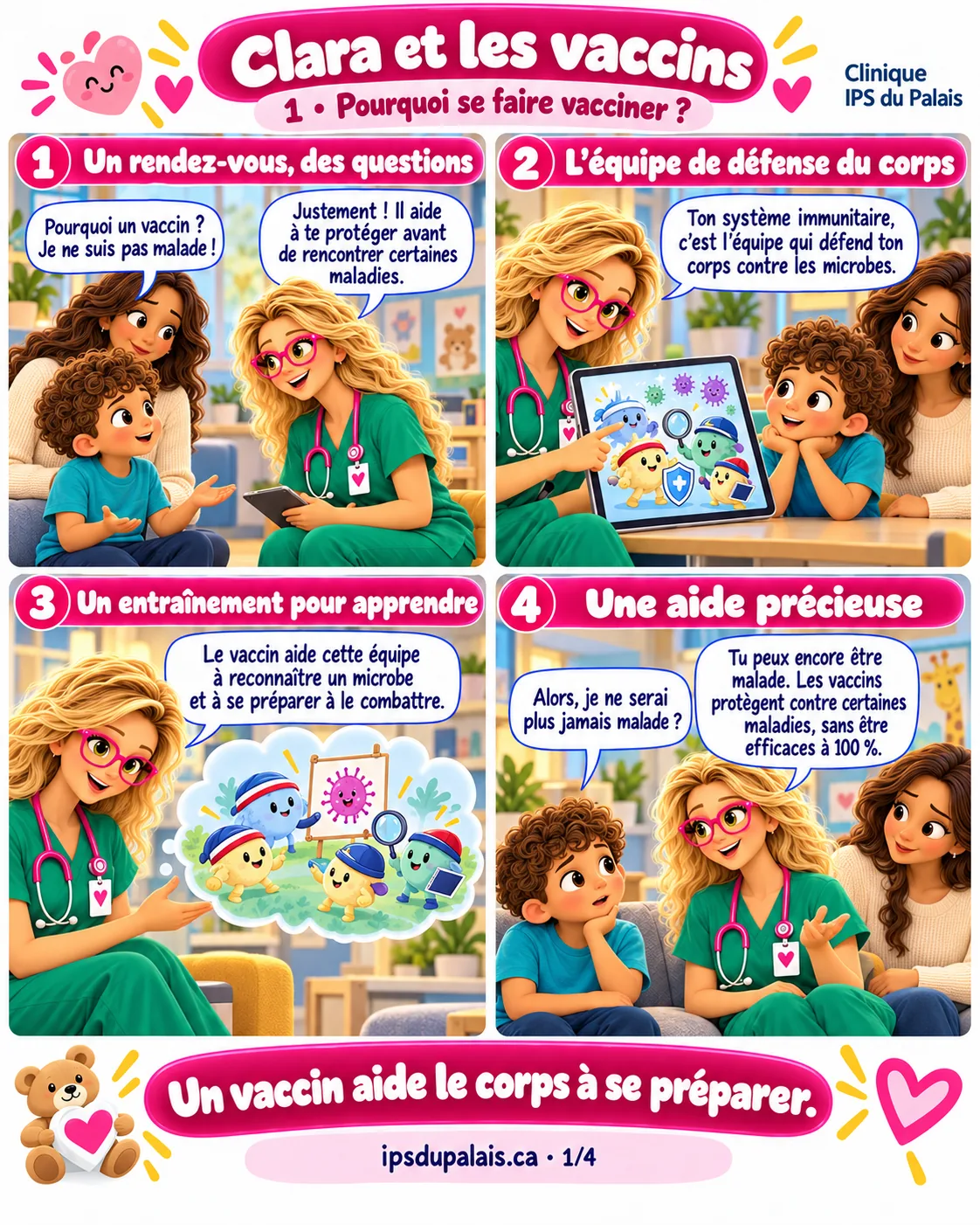
Page 1 — Why get vaccinated?
1. An appointment, some questions
- The child: “Why a vaccine? I’m not sick!”
- Clara: “Exactly! It helps protect you before you come across certain diseases.”
2. The body’s defence team
- Clara: “Your immune system is the team that defends your body against germs.”
3. Practice to learn
- Clara: “The vaccine helps this team recognize a germ and get ready to fight it.”
4. Valuable help
- The child: “So I’ll never be sick again?”
- Clara: “You can still get sick. Vaccines protect against certain diseases, but they are not 100% effective.”
“A vaccine helps the body get ready.”
Read together: what would you like to ask about vaccines?
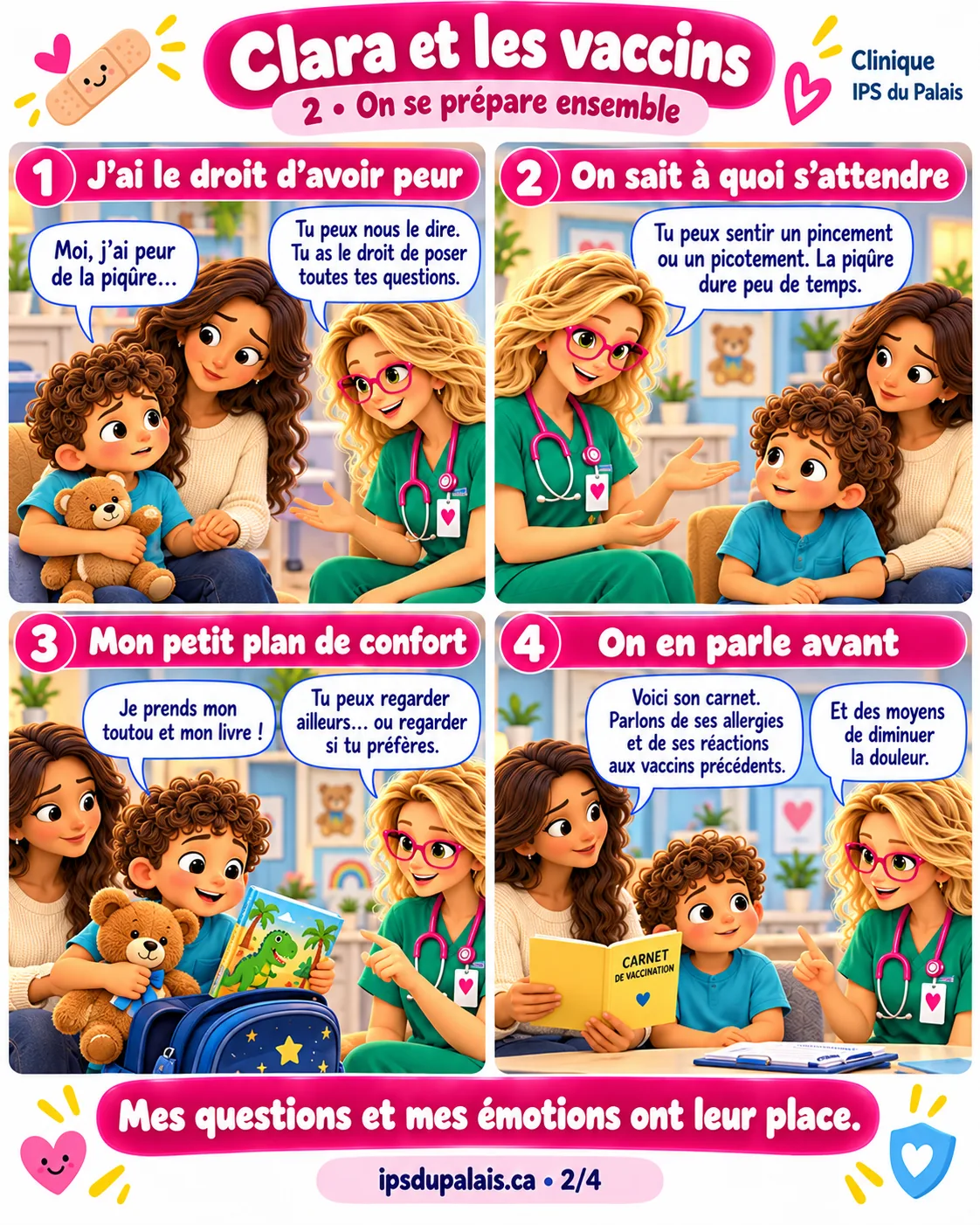
Page 2 — Getting ready together
1. It’s okay to be scared
- The child: “I’m scared of the needle…”
- Clara: “You can tell us. You can ask all your questions.”
2. We know what to expect
- Clara: “You may feel a pinch or a tingle. The needle only lasts a short time.”
3. My little comfort plan
- The child: “I’m bringing my teddy and my book!”
- Clara: “You can look away… or watch, if you prefer.”
4. We talk about it first
- The mother: “Here is his record. Let’s talk about his allergies and his reactions to previous vaccines.”
- Clara: “And about ways to reduce the pain.”
“My questions and my feelings matter.”
Read together: what could help you feel calmer?
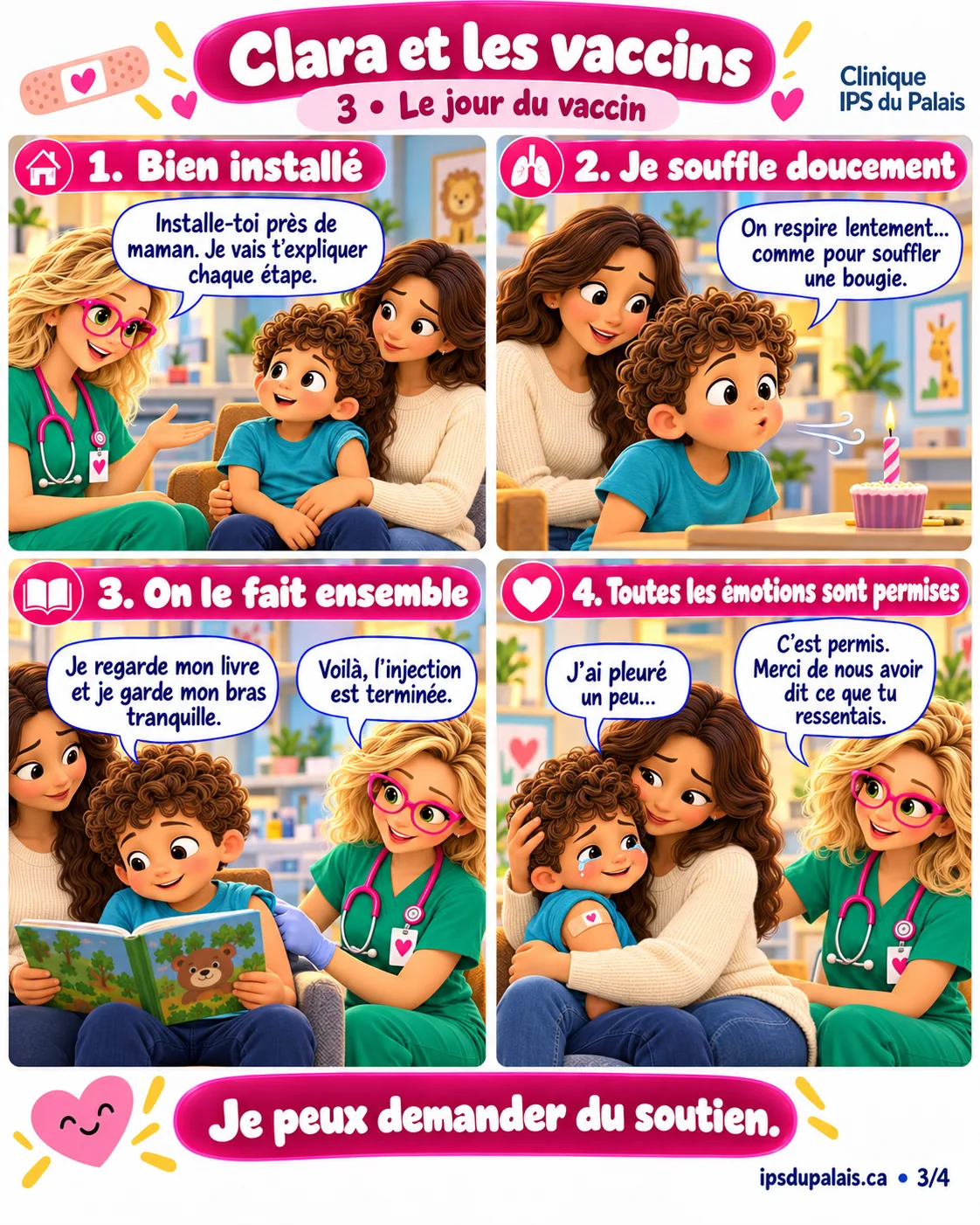
Page 3 — Vaccine day
1. Sitting comfortably
- Clara: “Sit next to your mom. I’ll explain each step to you.”
2. I breathe out gently
- Speech bubble: “We breathe slowly… like blowing out a candle.”
3. We do it together
- The child: “I look at my book and keep my arm still.”
- Clara: “There, the injection is done.”
4. All feelings are okay
- The child: “I cried a little…”
- Clara: “That’s okay. Thank you for telling us how you felt.”
“I can ask for support.”
Read together: who would you like to have next to you?
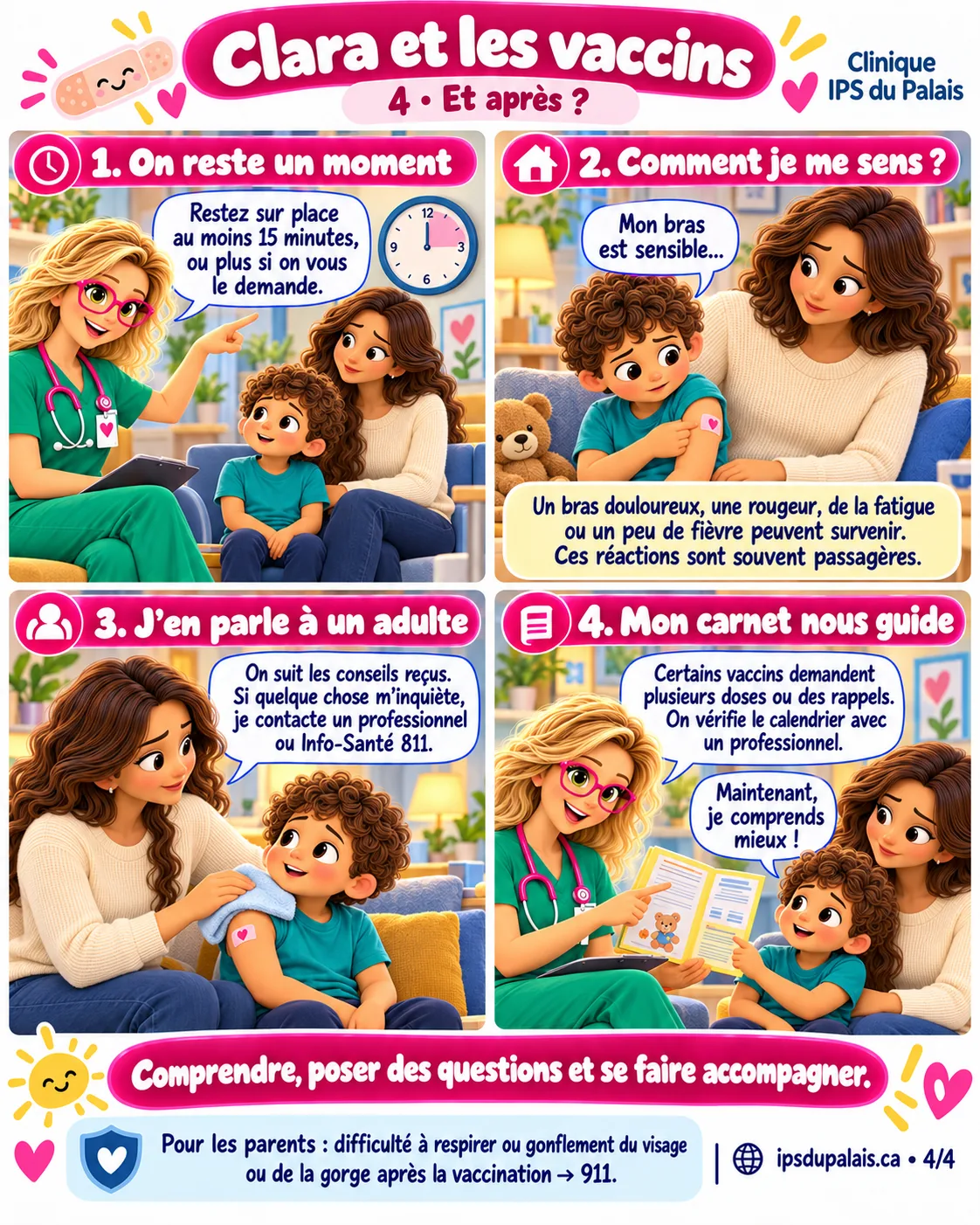
Page 4 — What happens next?
1. We stay a little while
- Clara: “Stay on site for at least 15 minutes, or longer if you are asked to.”
2. How do I feel?
- The child: “My arm is sore…”
- Text box: “A sore arm, redness, tiredness or a slight fever can happen. These reactions are often temporary.”
3. I tell an adult
- Speech bubble: “We follow the advice we were given. If something worries me, I contact a professional or Info-Santé 811.”
4. My record guides us
- Clara: “Some vaccines need several doses or boosters. We check the schedule with a professional.”
- The child: “Now I understand better!”
“Understanding, asking questions and getting support.”
Read together: who can you tell how you feel?
For parents (on page 4): difficulty breathing or swelling of the face or throat after vaccination → 911.
Note: educational comic; fictional characters; does not replace a consultation. Vaccination arrangements must be confirmed with the clinic or the vaccination services.
For parents: good to know
- A vaccine makes the immune system react and produce antibodies without the child catching the disease. No vaccine is 100% effective, but vaccination remains one of the most effective ways to protect health.
- To prepare your child, the Government of Québec advises not to promise that it won’t hurt, but to describe a prick, tingle or pinch that lasts only a short time. You can choose a comfort object together, encourage slow breathing and let your child watch if they want to. During the injection, hold your child on your lap, in the position shown by the person giving the vaccine.
- An over-the-counter numbing cream (lidocaine or tetracaine) can be applied 30 to 60 minutes before. Acetaminophen and ibuprofen are not recommended before the vaccine to prevent pain; they can help afterwards for pain or fever.
- Bring the vaccination record. Report any allergy and any severe reaction to a previous vaccine.
- Stay on site for at least 15 minutes after vaccination. A severe allergic reaction is very rare; it usually happens within minutes and can then be treated on site.
- Pain, redness or swelling where the needle went in, tiredness or a slight fever are common, mild and temporary. If you are worried, see a health professional or call Info-Santé 811.
- If your child has difficulty breathing, or if their face, lips, tongue or throat swell: at the clinic, tell the staff right away; anywhere else, call 911.
- Some vaccines need several doses or boosters, at ages set by the Québec Immunization Program schedule. Vaccination arrangements must be confirmed with the clinic or the vaccination services.
Sources: Government of Québec, Diminuer la douleur et l’anxiété liées à la vaccination chez les enfants and Comprendre la vaccination (in French, updated June 13, 2023), Programme québécois d’immunisation (in French, updated June 30, 2026); INSPQ, Vaccination de l’enfant (in French, updated July 10, 2026); Public Health Agency of Canada, Vaccines for children: What to expect at the vaccination appointment (modified February 20, 2026) and Vaccine safety and possible side effects (modified March 31, 2026). Consulted on October 21, 2026.

Psst… a little secret from Clara
In the comics, Clara puts on her scrubs to tell the story of the care. In real life, Clara is the website's virtual assistant: the clinic's nurses and health professionals are the ones who provide care. Clara is here to guide you around the website!
Kids' corner
More stories with Clara
Clara's comics are intended to inform children and their parents. They do not replace a consultation or an assessment by a health professional. In an emergency, call 911. For health advice, call Info-Santé 811. Page published on October 21, 2026.