
Kids' corner · Comic No 8
Clara and ADHD
A comic to help children understand ADHD: how it can show, how the assessment works at the clinic and which supports can be tried.
- 6 pages
- To read together
- ADHD

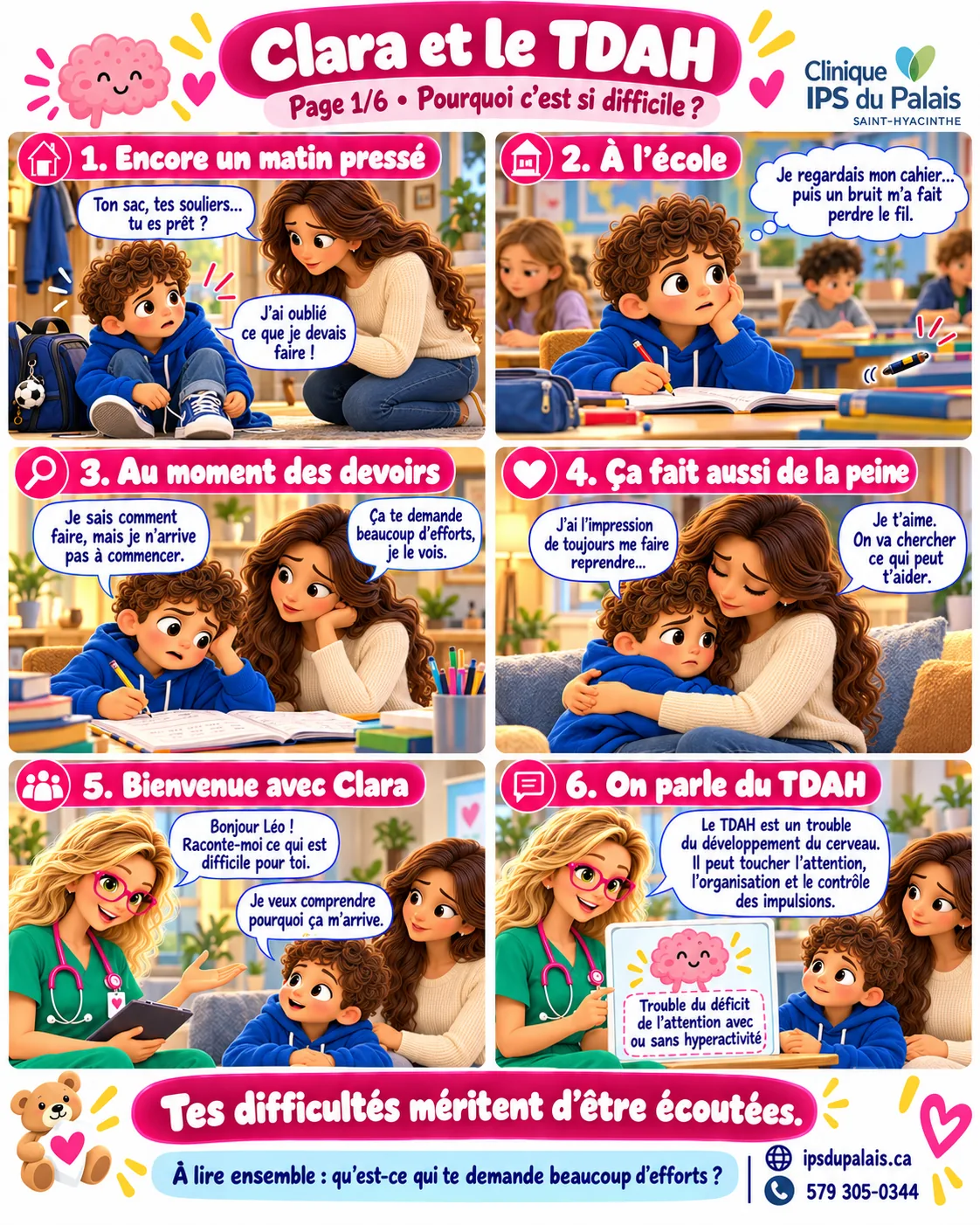 Enlarge page 1
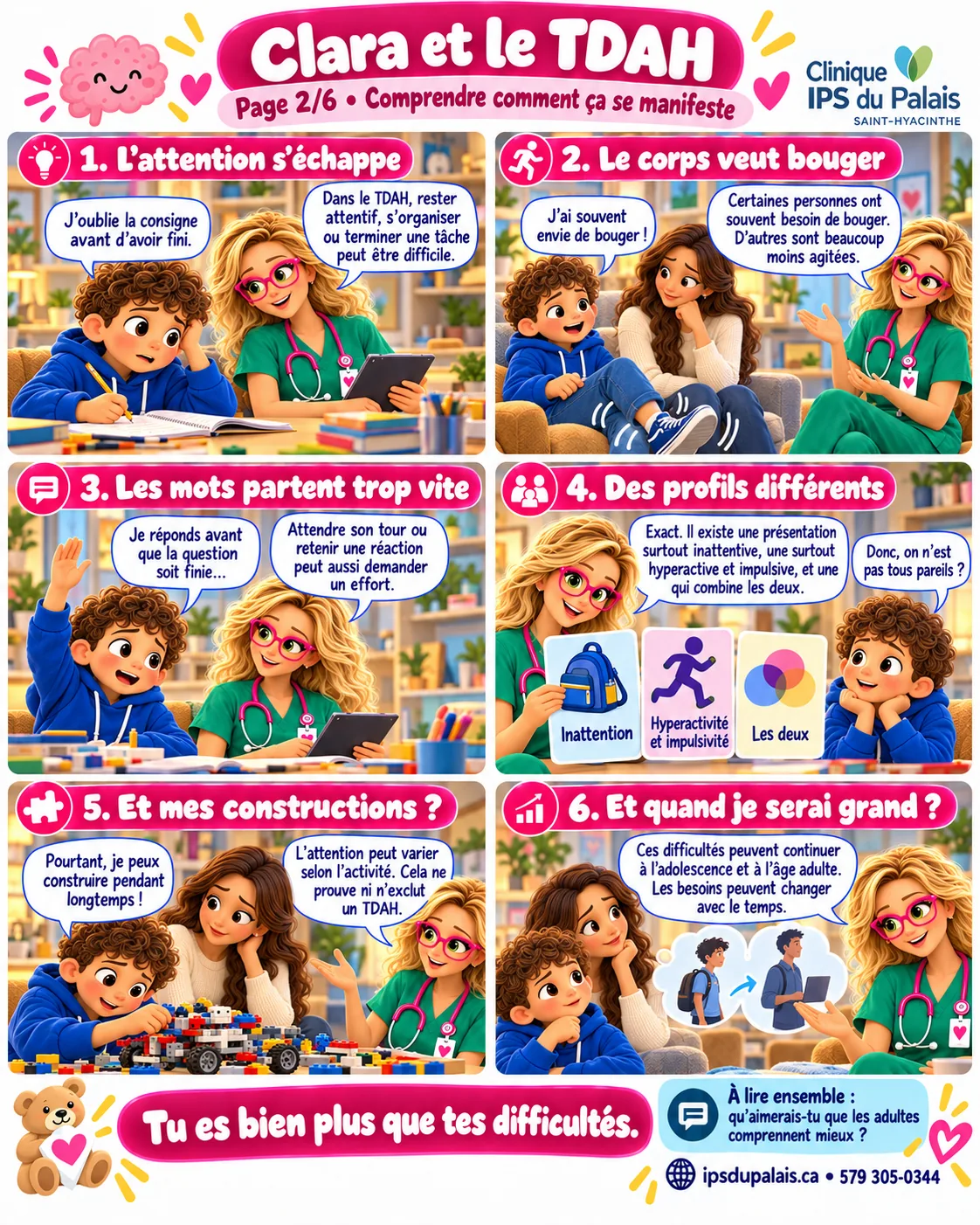 Enlarge page 2
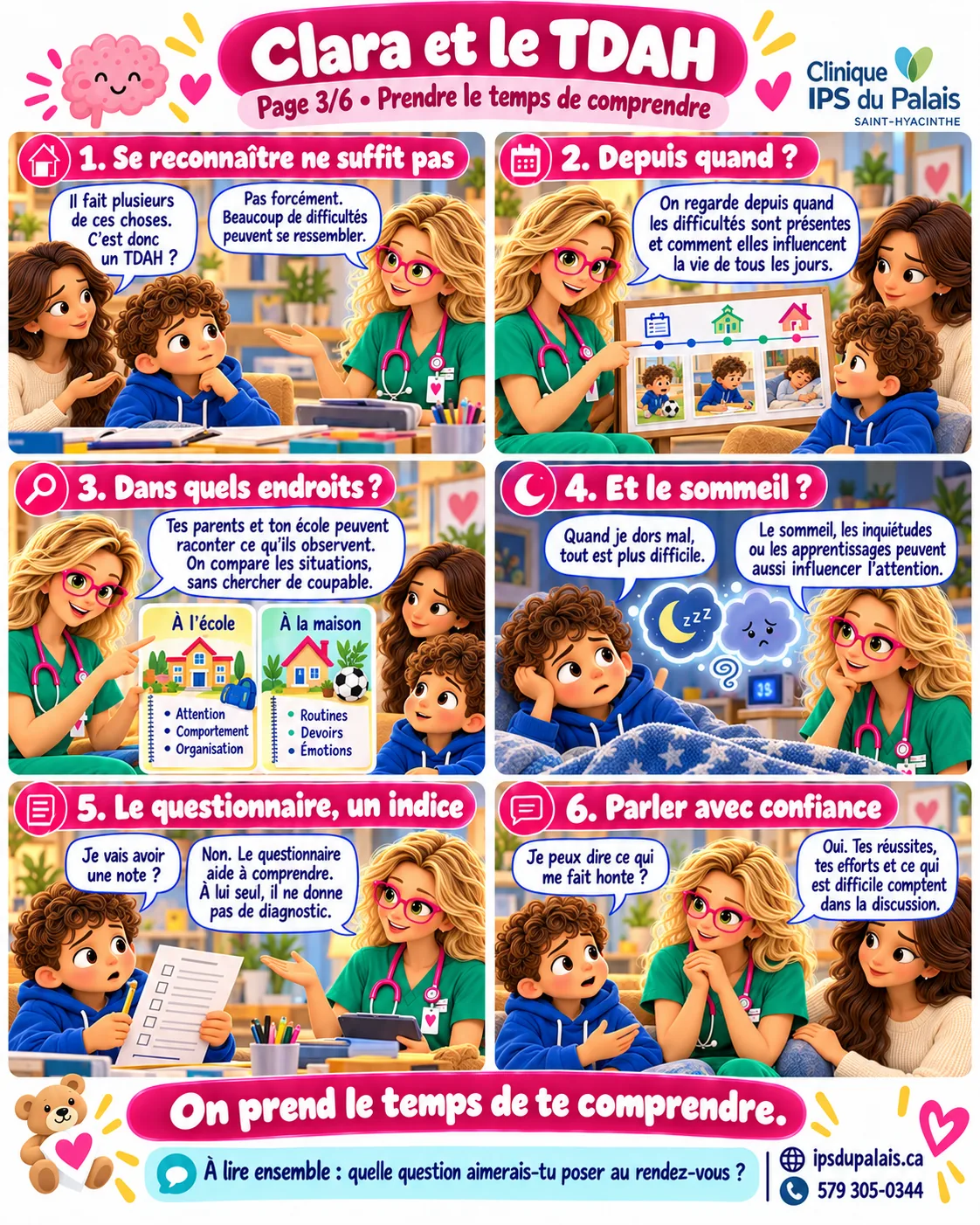 Enlarge page 3
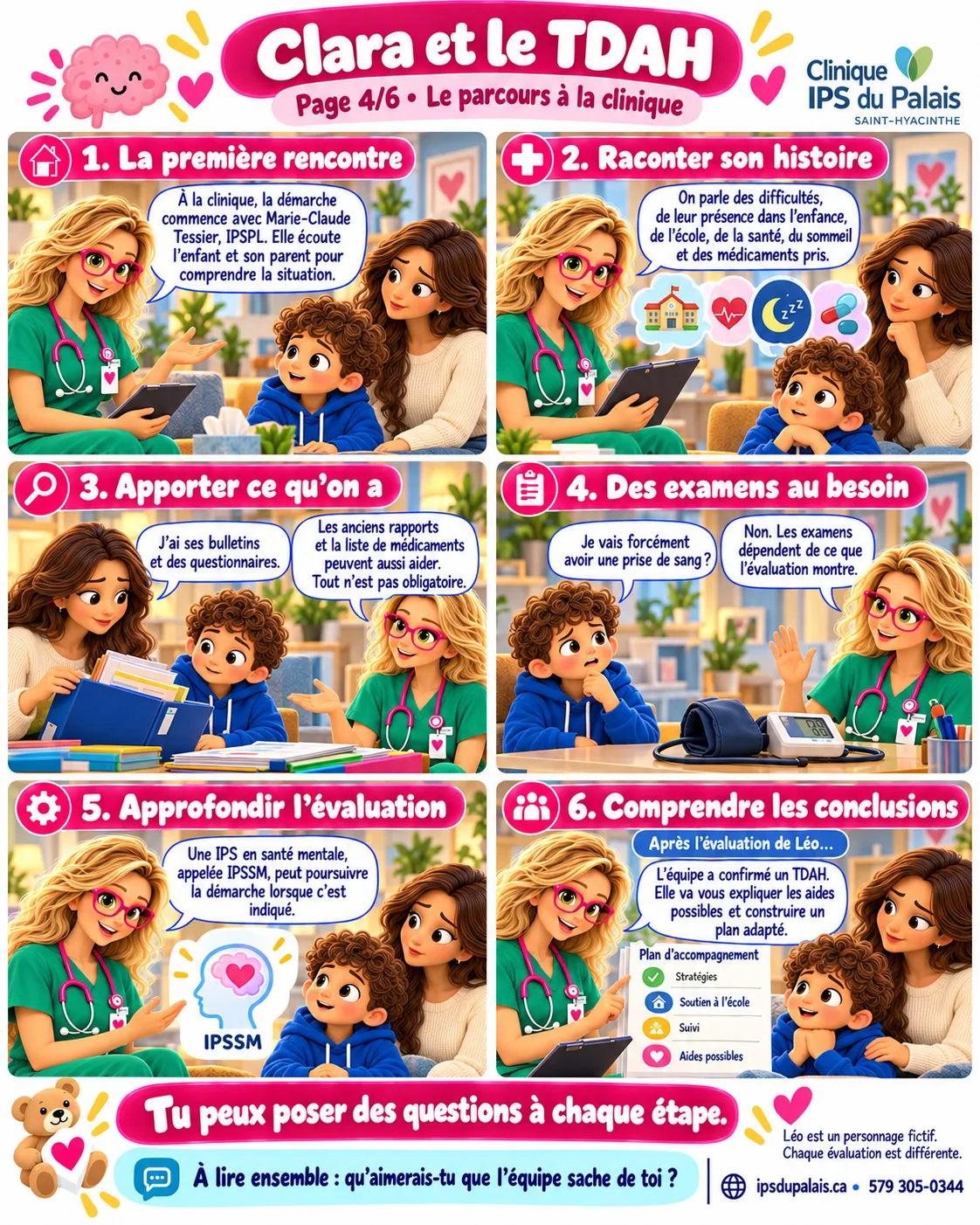 Enlarge page 4
 Enlarge page 5
 Enlarge page 6

Well done, you read the whole story!
You can read it again whenever you like, or choose another story with Clara.
Read the comic text in English
Page 1 — Why is it so hard?
1. Another rushed morning
- The mother: “Your bag, your shoes… are you ready?”
- Léo: “I forgot what I was supposed to do!”
2. At school
- Léo (thinking): “I was looking at my notebook… then a noise made me lose track.”
3. Homework time
- Léo: “I know how to do it, but I can't get started.”
- The mother: “It takes a lot of effort for you, I can see that.”
4. It hurts, too
- Léo: “I feel like I'm always being told off…”
- The mother: “I love you. We'll look for what can help you.”
5. Welcome with Clara
- Clara: “Hello Léo! Tell me what's hard for you.”
- Léo: “I want to understand why this happens to me.”
6. Talking about ADHD
- Clara: “ADHD is a brain development disorder. It can affect attention, organization and impulse control.”
- The board says: “Attention deficit disorder with or without hyperactivity”.
“Your difficulties deserve to be heard.”
To read together: What takes a lot of effort for you?
Page 2 — Understanding how it shows
1. Attention slips away
- Léo: “I forget the instruction before I'm done.”
- Clara: “With ADHD, staying focused, getting organized or finishing a task can be hard.”
2. The body wants to move
- Léo: “I often feel like moving!”
- Clara: “Some people often need to move. Others are much less restless.”
3. Words come out too fast
- Léo: “I answer before the question is finished…”
- Clara: “Waiting your turn or holding back a reaction can also take effort.”
4. Different profiles
- Clara: “Exactly. There is a mainly inattentive presentation, a mainly hyperactive and impulsive one, and one that combines both.”
- Léo: “So we're not all the same?”
- The cards show: inattention; hyperactivity and impulsivity; both.
5. What about my building?
- Léo: “But I can build things for a long time!”
- Clara: “Attention can vary with the activity. That neither proves nor rules out ADHD.”
6. And when I grow up?
- Clara: “These difficulties can continue into adolescence and adulthood. Needs can change over time.”
“You are so much more than your difficulties.”
To read together: What would you like adults to understand better?
Page 3 — Taking time to understand
1. Recognizing yourself isn't enough
- The mother: “He does several of these things. So it's ADHD?”
- Clara: “Not necessarily. Many difficulties can look alike.”
2. Since when?
- Clara: “We look at how long the difficulties have been there and how they affect everyday life.”
3. In which places?
- Clara: “Your parents and your school can describe what they notice. We compare situations, without looking for someone to blame.”
- The board shows: at school (attention, behaviour, organization); at home (routines, homework, emotions).
4. What about sleep?
- Léo: “When I sleep badly, everything is harder.”
- Clara: “Sleep, worries or learning can also affect attention.”
5. The questionnaire, a clue
- Léo: “Am I going to get a grade?”
- Clara: “No. The questionnaire helps us understand. On its own, it doesn't give a diagnosis.”
6. Talking with confidence
- Léo: “Can I say what makes me feel ashamed?”
- Clara: “Yes. Your successes, your efforts and what's hard all matter in the discussion.”
“We take the time to understand you.”
To read together: What question would you like to ask at the appointment?
Page 4 — The path at the clinic
1. The first meeting
- Clara: “At the clinic, the process starts with Marie-Claude Tessier, primary care NP (IPSPL). She listens to the child and parent to understand the situation.”
2. Telling your story
- Clara: “We talk about the difficulties, whether they were present in childhood, school, health, sleep and medications taken.”
3. Bringing what you have
- The mother: “I have his report cards and some questionnaires.”
- Clara: “Past reports and the medication list can also help. Not everything is required.”
4. Tests if needed
- Léo: “Will I have to get a blood test for sure?”
- Clara: “No. Tests depend on what the assessment shows.”
5. Going further with the assessment
- Clara: “A mental health nurse practitioner, called an IPSSM, can continue the process when appropriate.”
6. Understanding the conclusions
- Box: “After Léo's assessment…”
- Clara: “The team confirmed ADHD. They will explain the possible supports and build a plan that fits.”
- The support plan shows: strategies, school support, follow-up, possible supports.
“You can ask questions at every step.”
To read together: What would you like the team to know about you?
Note: Léo is a fictional character. Every assessment is different.
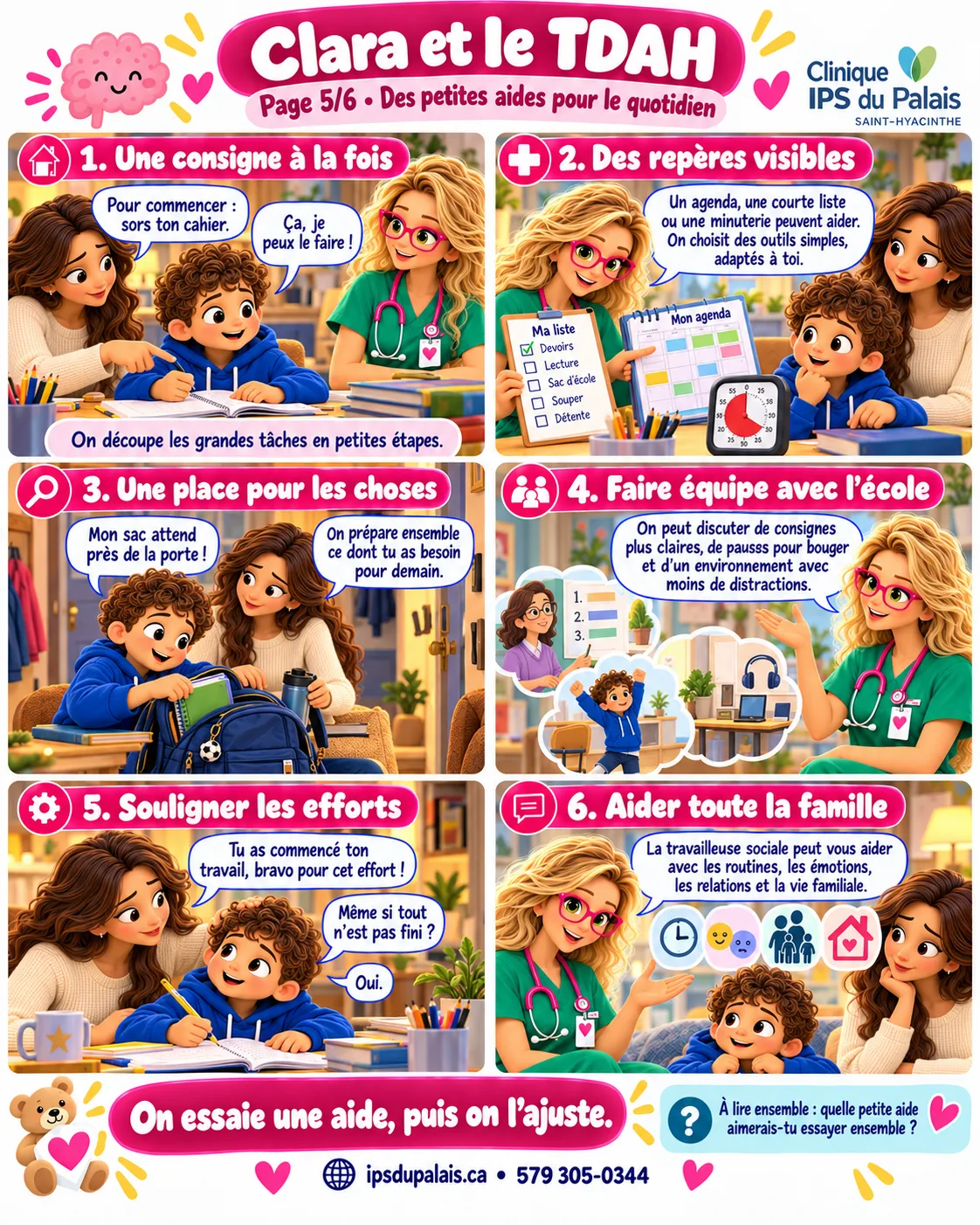
Page 5 — Little helps for every day
1. One instruction at a time
- The mother: “To start: take out your notebook.”
- Léo: “That, I can do!”
- Box: “We break big tasks into small steps.”
2. Visible reminders
- Clara: “A planner, a short list or a timer can help. We choose simple tools that suit you.”
- The list shows: homework, reading, school bag, supper, downtime.
3. A place for things
- Léo: “My bag waits by the door!”
- The mother: “We get ready together what you need for tomorrow.”
4. Teaming up with the school
- Clara: “We can talk about clearer instructions, breaks to move, and a setting with fewer distractions.”
5. Praising effort
- The mother: “You started your work, well done for that effort!”
- Léo: “Even if it's not all finished?”
- Answer: “Yes.”
6. Helping the whole family
- Clara: “The social worker can help you with routines, emotions, relationships and family life.”
“We try a help, then we adjust it.”
To read together: What small help would you like to try together?
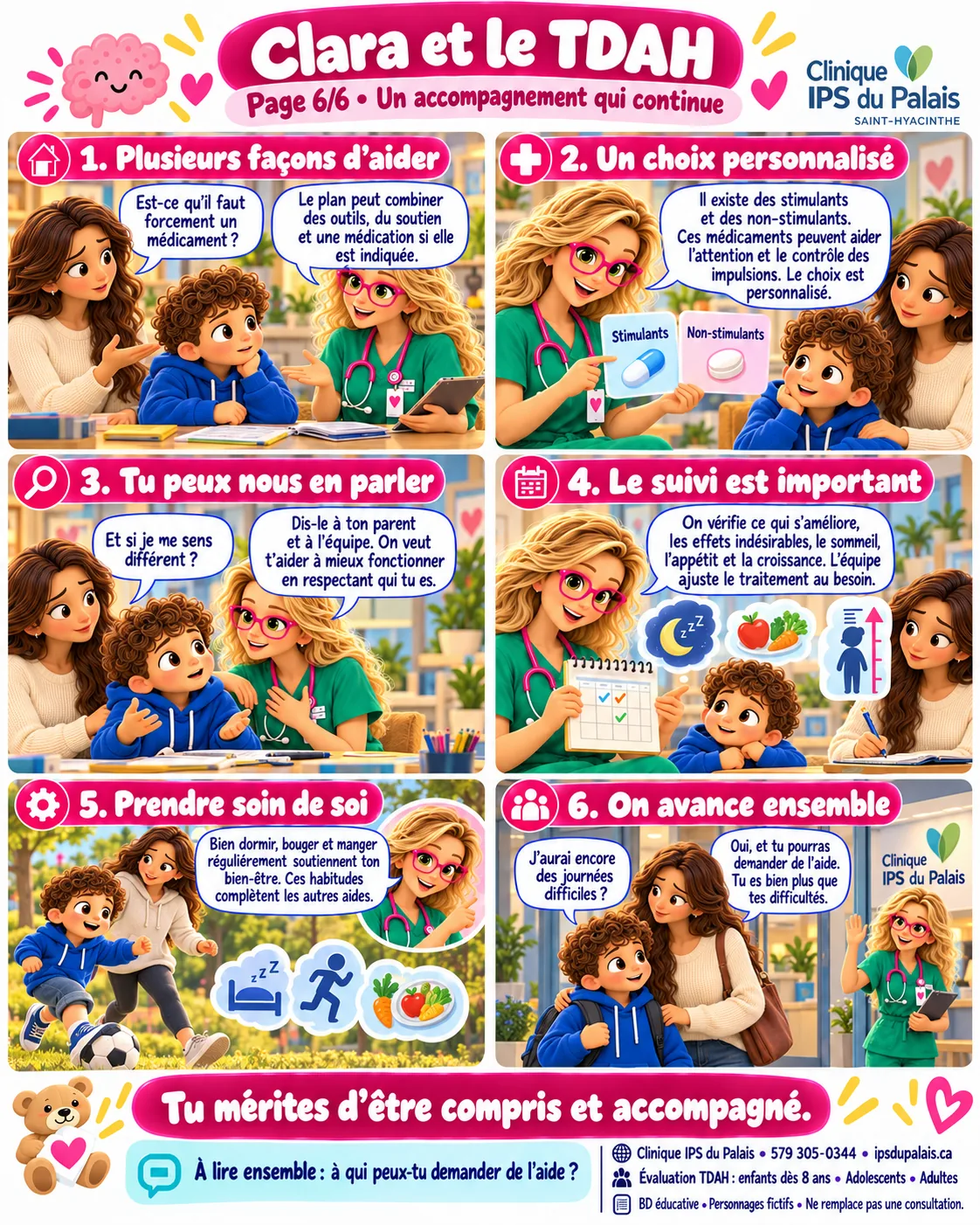
Page 6 — Support that continues
1. Many ways to help
- The mother: “Is medication always necessary?”
- Clara: “The plan can combine tools, support and medication if it's indicated.”
2. A personalized choice
- Clara: “There are stimulants and non-stimulants. These medications can help attention and impulse control. The choice is personalized.”
3. You can tell us
- Léo: “What if I feel different?”
- Clara: “Tell your parent and the team. We want to help you function better while respecting who you are.”
4. Follow-up matters
- Clara: “We check what's improving, side effects, sleep, appetite and growth. The team adjusts the treatment as needed.”
5. Taking care of yourself
- Clara: “Sleeping well, moving and eating regularly support your well-being. These habits add to the other supports.”
6. Moving forward together
- Léo: “Will I still have hard days?”
- The mother: “Yes, and you'll be able to ask for help. You are so much more than your difficulties.”
“You deserve to be understood and supported.”
To read together: Who can you ask for help?
Note: ADHD assessment: children from age 8, adolescents, adults. Educational comic; fictional characters; does not replace a consultation.
For parents: good to know
- ADHD shows up as attention difficulties, with or without impulsivity and hyperactivity. According to the Government of Québec, it persists into adulthood in 50 to 65% of cases.
- The Government of Québec recommends seeing a health professional when symptoms cause distress, interfere with functioning at home, school or work, or affect relationships, and have lasted more than six months.
- Care recognized as effective may or may not include medication: psychosocial and behavioural interventions, school accommodations, healthy lifestyle habits (sleep, physical activity, nutrition) and family involvement.
- According to CADDRA, treatment is often multimodal and individualized. Regular follow-up includes the growth chart for children and, at any age, side effects.
- At Clinique IPS du Palais, ADHD assessment is offered to children from age 8, adolescents and adults.
Sources: Government of Québec, Trouble du déficit de l’attention avec ou sans hyperactivité (TDAH) (in French, updated December 9, 2024); CADDRA, Canadian ADHD Practice Guidelines, 4.1 edition (2020), p. 11. Consulted on October 16, 2026.

Psst… a little secret from Clara
In the comics, Clara puts on her scrubs to tell the story of the care. In real life, Clara is the website's virtual assistant: the clinic's nurses and health professionals are the ones who provide care. Clara is here to guide you around the website!
Kids' corner
More stories with Clara
Clara's comics are intended to inform children and their parents. They do not replace a consultation or an assessment by a health professional. In an emergency, call 911. For health advice, call Info-Santé 811. Page published on October 16, 2026.